
2025-12-04 麻布大学
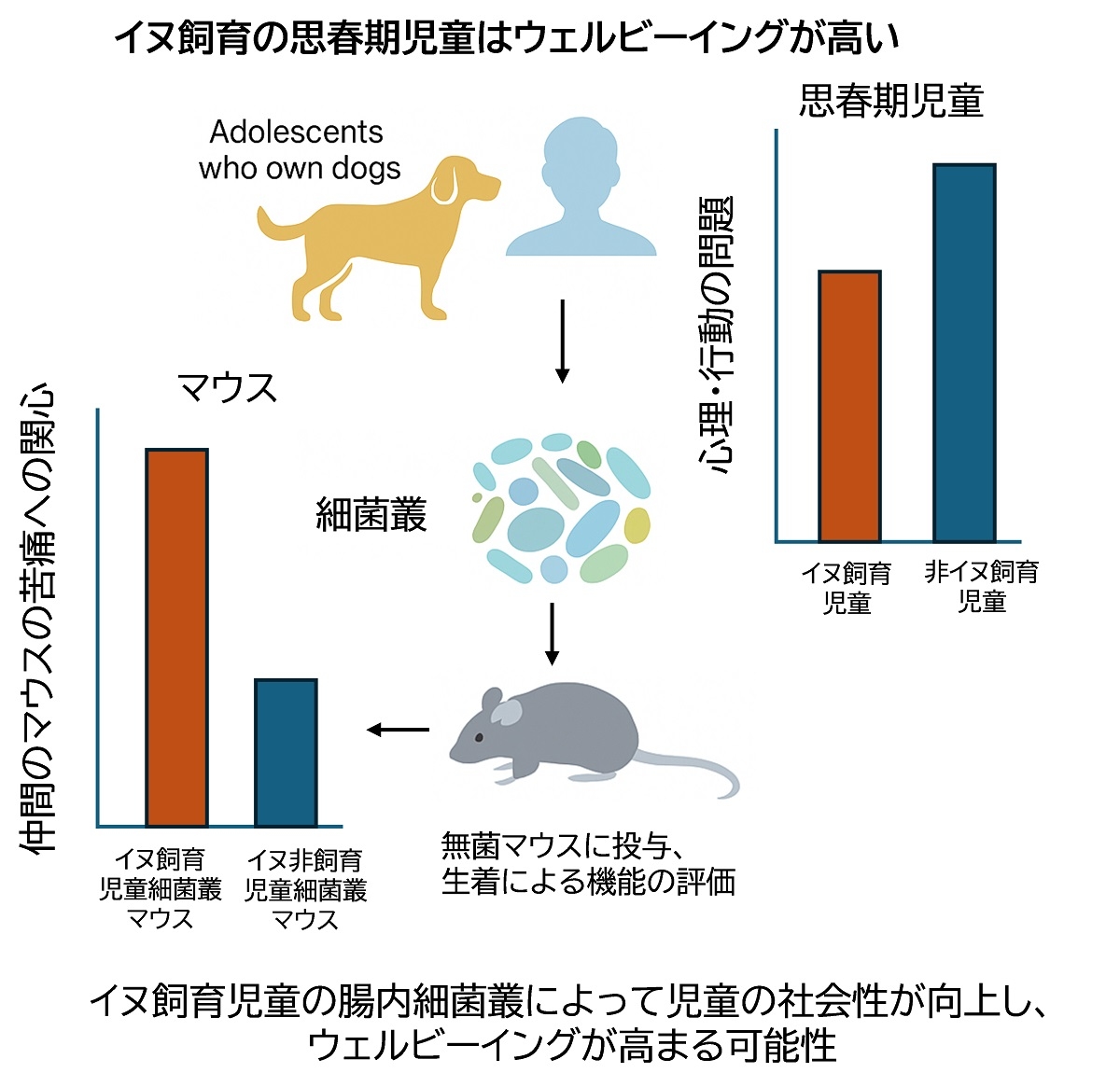
<関連情報>
- https://www.azabu-u.ac.jp/topics/2025/1204_47472.html
- https://www.cell.com/iscience/fulltext/S2589-0042(25)02209-6
思春期に犬を飼うことは腸内細菌叢を変化させ、精神的健康を改善する Dog ownership during adolescence alters the microbiota and improves mental health
Eiji Miyauchi ∙ Miku Yamaoka ∙ Itsuka Kamimura ∙ … ∙ Kazutaka Mogi ∙ Miho Nagasawa ∙ Takefumi Kikusui
iScience Published:December 3, 2025
DOI:https://doi.org/10.1016/j.isci.2025.113948
Highlights
- Dog ownership in adolescence is linked to improved mental health
- Adolescents with dogs show distinct microbiota profiles
- Dog-related microbiota transfer enhances mouse social behavior
- Streptococcus ASVs correlate with well-being in adolescents and mice
Summary
Adolescents who own dogs have higher well-being than those who do not; however, it is unclear what the underlying mechanism explains how dog ownership affects adolescents’ well-being. As dog ownership influences the composition of the microbiota in the home environment, we examined the microbiome of dog-owning adolescents and analyzed associations with mental health and behavior in the teenage cohort participants (n = 345). Our findings reveal that dog-owning adolescents showed fewer problems with psychological scores, and some commensals were correlated with adolescents’ psychological scores. Mice treated with the microbiota of dog-owning adolescents showed a higher social approach to a trapped cagemate. An association analysis was conducted between the adolescents’ psychological scores and the mouse behavior with the abundance of each amplicon sequence variant (ASV) of the microbiome, and we found that ASVs belonging to Streptococcus were correlated with the social approach in ex-germ-free mice and mental scores in adolescents. These results suggest that microbiota may be partly involved in improving the well-being of adolescents living with dogs.
