2025-12-03 名古屋市立大学
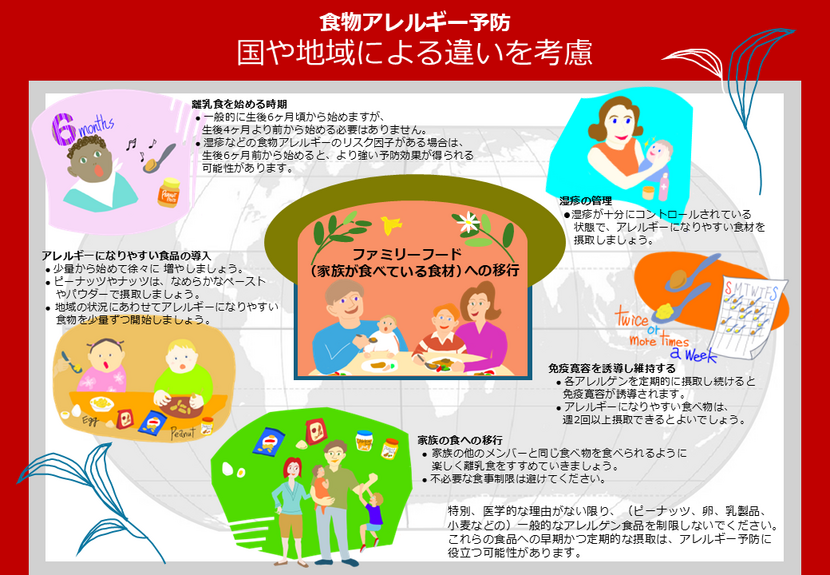
湿疹やアトピー性皮膚炎の既往があるお子さんは、すでに食物アレルギーを発症している可能性があります。アレルギーの原因になりやすい食品の摂取について自己判断で開始せず、必ず医師の指導の下で行ってください。
<関連情報>
- https://www.nagoya-cu.ac.jp/med/achievement/20251203press/
- https://www.nagoya-cu.ac.jp/med/media/20251203pressrelease.pdf
- https://www.jaci-inpractice.org/article/S2213-2198(25)01023-2/fulltext
早期の食物導入による食物アレルギー予防:「二重アレルゲン曝露不足理論」による東洋と西洋の出会い Preventing Food Allergy by Early Food Introduction: East Meets West with the ‘Lack Dual-Allergen Exposure Theory’
Kiwako Yamamoto-Hanada, MD, PhD ∙ Jennifer J. Koplin, PhD ∙ Marion Groetch, MS, RDN ∙ George du Toit, MD ∙ Yukihiro Ohya, MD, PhD
The Journal of Allergy and Clinical Immunology: In Practice Published:November 2, 2025
DOI:https://doi.org/10.1016/j.jaip.2025.10.036
Abstract
Food allergy (FA) is a growing global health concern with prevalence varying by region, influenced by genetic, environmental, and cultural factors. Eczema represents the strongest early-life risk factor, supporting the Lack dual-allergen exposure hypothesis in which disrupted skin barriers facilitate sensitization, while timely oral exposure promotes tolerance. Over recent decades, prevention strategies have shifted from allergen avoidance to early introduction, particularly after the LEAP study. Although early egg introduction has been associated with a reduced risk of egg allergy in some studies, others have reported no significant effect. In contrast, early peanut introduction has strong preventive effects in Western countries with high peanut allergy prevalence but appears less impactful in Japan, where peanut consumption and prevalence are low. The role of early cow’s milk introduction remains inconclusive, though recent Japanese data suggest possible benefit from small daily intake. Effective eczema management, including proactive anti-inflammatory therapy, may be crucial, as moisturizers alone are insufficient for FA prevention. Sustained and regular allergen intake after early introduction is likely to further support long-term tolerance. Prevention strategies must also account for cultural feeding practices, family dietary habits, and regional epidemiology, as these factors shape feasibility and public health relevance. Supporting a smooth transition to family foods—encouraging infants to share family meals without unnecessary restrictions—may help sustain tolerance and promote healthy eating patterns. Collaboration between Eastern and Western medical communities will be essential to harmonize evidence with cultural practices and develop effective, personalized FA prevention strategies worldwide. (244/250)