2025-12-04 京都大学
<関連情報>
- https://www.kyoto-u.ac.jp/ja/research-news/2025-12-04-1
- https://www.kyoto-u.ac.jp/sites/default/files/2025-12/web_2512_Nakanishi-451f9b7a4dd320a6855f681ce9ab1101.pdf
- https://www.nature.com/articles/s41467-025-66485-2
線維芽細胞由来トロンボスポンジン2を標的とすることで、大腸癌の腫瘍前線における免疫排除環境を破壊する Targeting fibroblast derived thrombospondin 2 disrupts an immune-exclusionary environment at the tumor front in colorectal cancer
Kosuke Iwane,Yuki Nakanishi,Yu Muta,Jiayu Chen,Kento Yasumura,Mayuki Omatsu,Naoki Aoyama,Munehiro Ikeda,Yoko Masui,Liyang Cai,Go Yamakawa,Kensuke Hamada,Kenta Mizukoshi,Munenori Kawai,Kei Iimori,Shinnosuke Nakayama,Nobukazu Agatsuma,Takahiro Utsumi,Munemasa Nagao,Takahisa Maruno,Yukiko Hiramatsu,Nobuyuki Kakiuchi,Masahiro M. Nakagawa,Yasuhiro Fukui,… Hiroshi Seno
Nature Communications
We are providing an unedited version of this manuscript to give early access to its findings. Before final publication, the manuscript will undergo further editing. Please note there may be errors present which affect the content, and all legal disclaimers apply.
Abstract
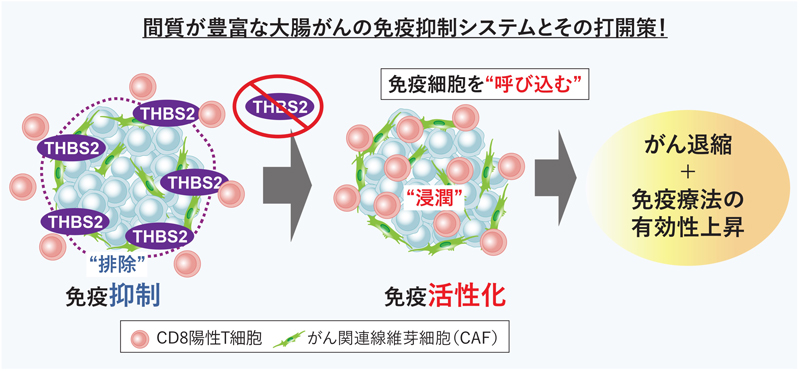
Fibrotic colorectal cancers (CRC) are largely microsatellite-stable and display desmoplastic stroma with poor immune infiltration. Here we identify thrombospondin-2 (THBS2) as a key regulator of the immune-exclusionary phenotype in fibrotic CRC. THBS2 is highly expressed by matrix cancer-associated fibroblasts at the tumor front. In an orthotopic model using desmoplastic tumor organoids, global or fibroblast-specific Thbs2 deletion disrupts the exclusionary barrier and increases intratumoral CD8 T cells. Mechanistically, THBS2 limits recruitment of CXCR3+ CD8 T cells by restraining dendritic- and macrophage-derived CXCL9/10. Depletion of these myeloid cells or blockade of CXCL9/10-CXCR3 signaling abolishes the enhanced CD8 T-cell influx and antitumor efficacy. Spatial profiling demonstrates that THBS2 loss induces proximity between CD8 T cells and myeloid cells and upregulates chemokines. Despite increased infiltration, CD8 T cells manifest exhaustion, rendering tumors highly susceptible to immune checkpoint blockade. THBS2 thus represents a tractable CAF-restricted target to overcome immune exclusion in fibrotic CRCs.