
2025-12-08 ノースウェスタン大学
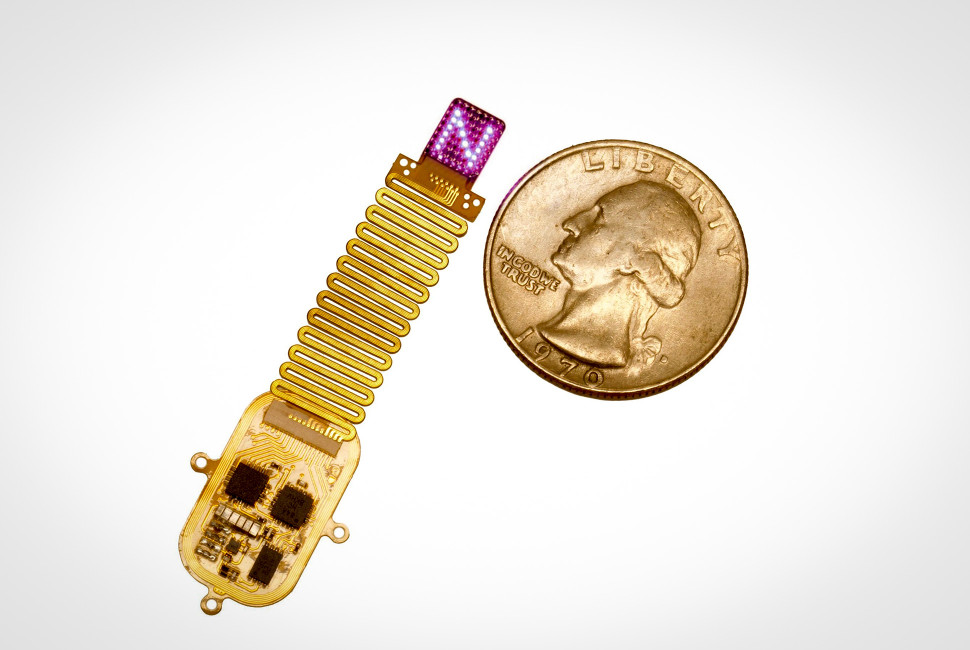
Roughly the size of a postage stamp and thinner than a credit card, the new device is less invasive than what had been developed previously by the team. Instead of extending into the brain through a tiny cranial defect, the new soft, flexible device conforms to the surface of the skull and shines light through the bone. Photo by Mingzheng Wu of the Rogers Research Group
<関連情報>
- https://news.northwestern.edu/stories/2025/12/wireless-device-speaks-to-the-brain-with-light
- https://www.nature.com/articles/s41593-025-02127-6
- https://www.nature.com/articles/s41593-021-00849-x
パターン化された無線経頭蓋光遺伝学が人工知覚を生成する Patterned wireless transcranial optogenetics generates artificial perception
Mingzheng Wu,Yiyuan Yang,Jinglan Zhang,Andrew I. Efimov,Xiuyuan Li,Kaiqing Zhang,Yue Wang,Kevin L. Bodkin,Mohammad Riahi,Jianyu Gu,Glingna Wang,Minsung Kim,Liangsong Zeng,Jiaqi Liu,Lauren H. Yoon,Haohui Zhang,Sara N. Freda,Minkyu Lee,Jiheon Kang,Joanna L. Ciatti,Kaila Ting,Stephen Cheng,Xincheng Zhang,He Sun,… John A. Rogers
Nature Neuroscience Published:08 December 2025
DOI:https://doi.org/10.1038/s41593-025-02127-6
Abstract
Synthesizing perceivable artificial neural inputs independent of typical sensory channels remains a fundamental challenge in developing next-generation brain-machine interfaces. Establishing a minimally invasive, wirelessly effective and miniaturized platform with long-term stability is crucial for creating research methods and clinically meaningful biointerfaces capable of mediating artificial perceptual feedback. Here we demonstrate a miniaturized, fully implantable transcranial optogenetic neural stimulator designed to generate artificial perceptions by patterning large cortical ensembles wirelessly in real time. Experimentally validated numerical simulations characterized light and heat propagation, whereas neuronal responses were assessed by in vivo electrophysiology and molecular methods. Cue discrimination during operant learning demonstrated the wireless genesis of artificial percepts sensed by mice, where spatial distance across large cortical networks and sequential order-based analyses of discrimination predicted performance. These conceptual and technical advances expand understanding of artificially patterned neural activity and its perception by the brain to guide the evolution of next-generation all-optical brain-machine communication.
個体および社会行動の光遺伝学的研究のためのワイヤレス多国間デバイス Wireless multilateral devices for optogenetic studies of individual and social behaviors
Yiyuan Yang,Mingzheng Wu,Abraham Vázquez-Guardado,Amy J. Wegener,Jose G. Grajales-Reyes,Yujun Deng,Taoyi Wang,Raudel Avila,Justin A. Moreno,Samuel Minkowicz,Vasin Dumrongprechachan,Jungyup Lee,Shuangyang Zhang,Alex A. Legaria,Yuhang Ma,Sunita Mehta,Daniel Franklin,Layne Hartman,Wubin Bai,Mengdi Han,Hangbo Zhao,Wei Lu,Yongjoon Yu,Xing Sheng,… John A. Rogers
Nature Neuroscience Published:10 May 2021
DOI:https://doi.org/10.1038/s41593-021-00849-x
An Author Correction to this article was published on 07 September 2022
This article has been updated
Abstract
Advanced technologies for controlled delivery of light to targeted locations in biological tissues are essential to neuroscience research that applies optogenetics in animal models. Fully implantable, miniaturized devices with wireless control and power-harvesting strategies offer an appealing set of attributes in this context, particularly for studies that are incompatible with conventional fiber-optic approaches or battery-powered head stages. Limited programmable control and narrow options in illumination profiles constrain the use of existing devices. The results reported here overcome these drawbacks via two platforms, both with real-time user programmability over multiple independent light sources, in head-mounted and back-mounted designs. Engineering studies of the optoelectronic and thermal properties of these systems define their capabilities and key design considerations. Neuroscience applications demonstrate that induction of interbrain neuronal synchrony in the medial prefrontal cortex shapes social interaction within groups of mice, highlighting the power of real-time subject-specific programmability of the wireless optogenetic platforms introduced here.

