2025-12-10 インペリアル・カレッジ・ロンドン(ICL)
<関連情報>
- https://www.imperial.ac.uk/news/articles/natural-sciences/life-sciences/2025/imperial-led-project-brings-gene-drive-mosquitoes-closer-to-reality-in-africa/#d.en.1718054
- https://www.nature.com/articles/s41586-025-09685-6
遺伝子ドライブ可能な蚊がタンザニアで患者由来のマラリアを抑制 Gene-drive-capable mosquitoes suppress patient-derived malaria in Tanzania
Tibebu Habtewold,Dickson Wilson Lwetoijera,Astrid Hoermann,Rajabu Mashauri,Fatuma Matwewe,Rehema Mwanga,Prisca Kweyamba,Gilbert Maganga,Beatrice Philip Magani,Rachel Mtama,Moze Ally Mahonje,Mgeni Mohamed Tambwe,Felista Tarimo,Pratima R. Chennuri,Julia A. Cai,Giuseppe Del Corsano,Paolo Capriotti,Peter Sasse,Jason Moore,Douglas Hudson,Alphaxard Manjurano,Brian Tarimo,Dina Vlachou,Sarah Moore,… George K. Christophides
Nature Published:10 December 2025
DOI:https://doi.org/10.1038/s41586-025-09685-6
Abstract
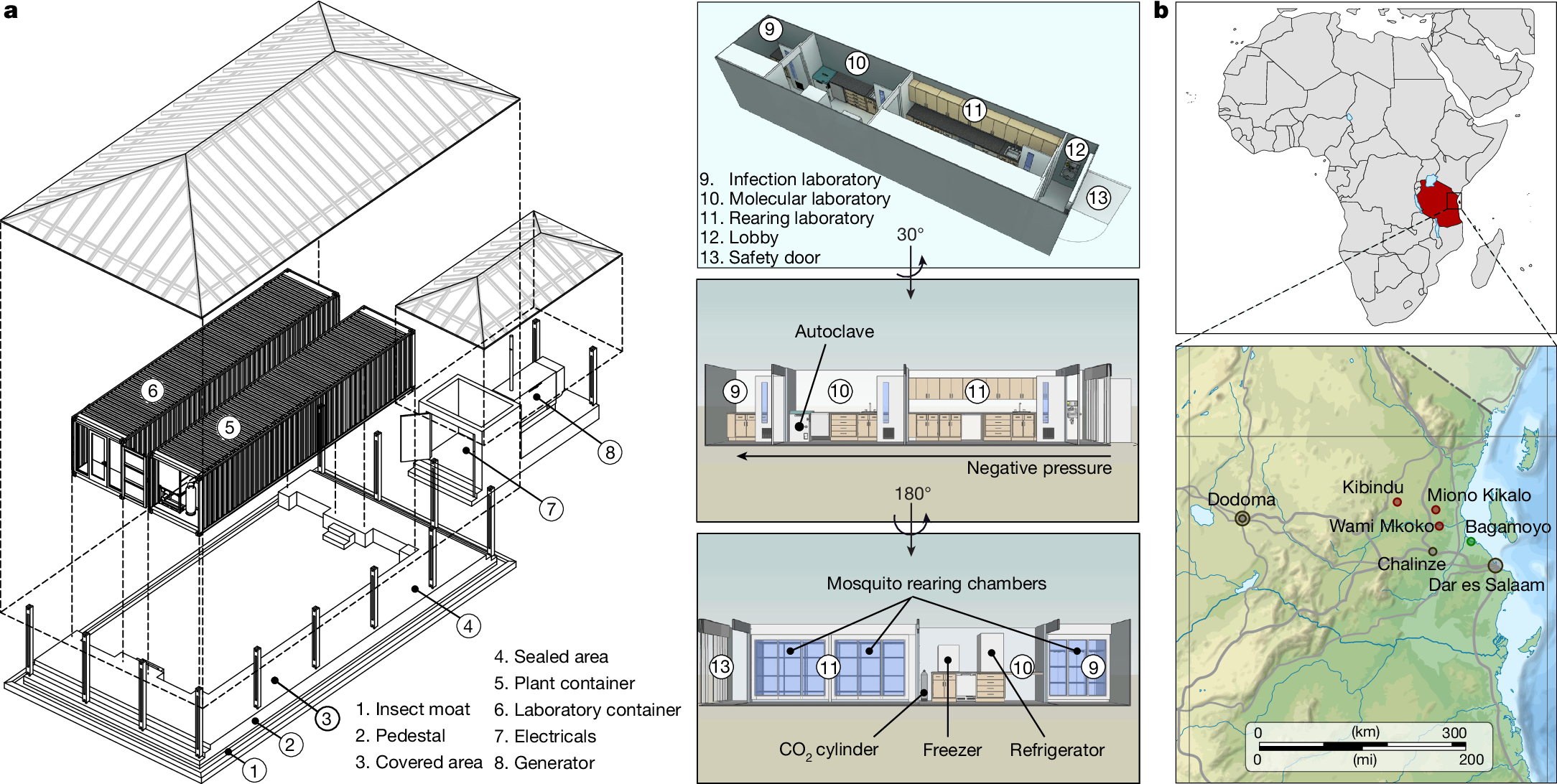
Gene drive technology presents a transformative approach to combatting malaria by introducing genetic modifications into wild mosquito populations to reduce their vectorial capacity. Although effective modifications have been developed, these efforts have been confined to laboratories in the global north. We previously demonstrated that modifying Anopheles gambiae to express two exogenous antimicrobial peptides inhibits the sporogonic development of laboratory-cultured Plasmodium falciparum, with models predicting substantial contributions to malaria elimination in Africa when integrated with gene drive1,2,3. However, the effectiveness of this modification against genetically diverse, naturally circulating parasite isolates remained unknown. To address this critical gap, we adapted our technology for an African context by establishing infrastructural and research capacity in Tanzania, enabling the engineering of local A. gambiae under containment. Here we report the generation of a transgenic strain equipped with non-autonomous gene drive capabilities that robustly inhibits genetically diverse P. falciparum isolates obtained from naturally infected children. These genetic modifications were efficiently inherited by progeny when supplemented with Cas9 endonuclease provided by another locally engineered strain. Our work brings gene drive technology a critical step closer to application, providing a locally tailored and powerful tool for malaria eradication through the targeted dissemination of beneficial genetic traits in wild mosquito populations.