2025-12-12 ロックフェラー大学
<関連情報>
- https://www.rockefeller.edu/news/38777-this-new-one-two-punch-could-knock-out-drug-resistant-tb/
- https://www.nature.com/articles/s41564-025-02201-6
転写共阻害は薬剤耐性の進化を変化させ、結核菌の肉芽腫からの排除を促進する Transcription co-inhibition alters drug resistance evolution and enhances Mycobacterium tuberculosis clearance from granulomas
Barbara Bosch,Vanisha Munsamy-Govender,Jansy Sarathy,Mirjana Lilic,Paul Dominic B. Olinares,Kathryn A. Eckartt,Pranav Nalam,Markus Lang,Marcell Simon,Adrian Richter,Jeremy M. Rock & Elizabeth A. Campbell
Nature Microbiology Published:03 December 2025
DOI:https://doi.org/10.1038/s41564-025-02201-6
Abstract
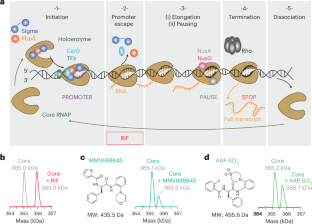
Mycobacterium tuberculosis (Mtb), the causative agent of tuberculosis, remains the deadliest human pathogen. Treatment is hampered by drug resistance and the persistence of slow-growing or non-replicating populations. Rifampicin, a cornerstone of first-line therapy, inhibits transcription during promoter escape, but resistance mutations undermine efficacy and drive resistance spread. We revisited the transcription cycle as an antibacterial target by characterizing AAP-SO2, an RNA polymerase inhibitor with whole-cell activity against Mtb. AAP-SO2 slows the nucleotide addition cycle, disrupting elongation and termination. Rifampicin-resistant mutations impose fitness costs by perturbing the balance of these steps, creating exploitable weaknesses. Inhibition of transcription with AAP-SO2 reduced the evolution of rifampicin resistance and was especially effective against the most common resistant mutant. Combination treatment with rifampicin and AAP-SO2 synergistically killed non-replicating Mtb in an ex vivo rabbit granuloma model. These findings show that exploiting functional vulnerabilities of the transcription cycle can counter rifampicin resistance and improve clearance of recalcitrant Mtb populations.