2026-01-02 韓国基礎科学研究院(IBS)
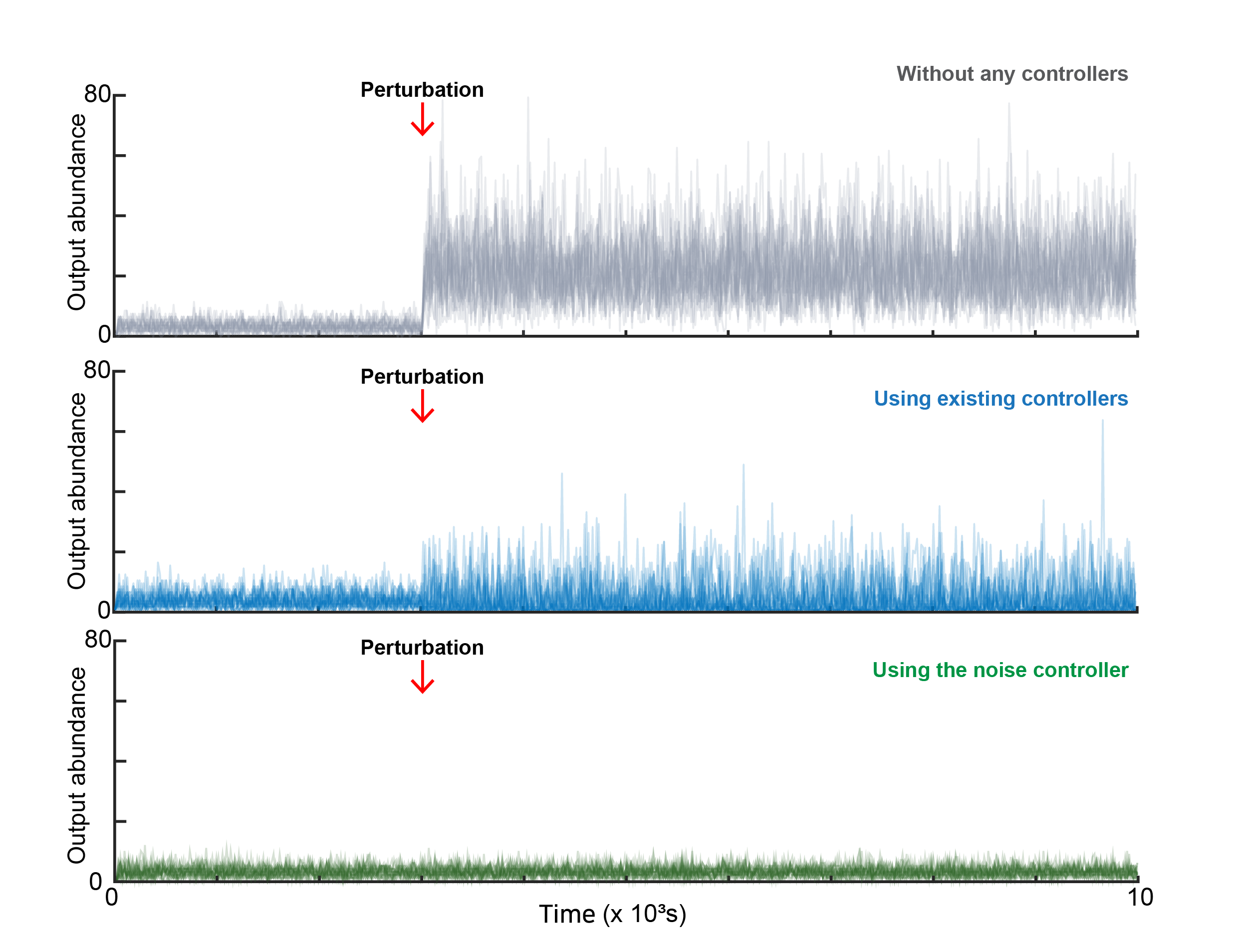
Figure 1. It is possible to reduce the biological noise to a desired level. Without any control mechanism, external stimuli cause the population-level average of cellular outputs to shift. Existing control strategies can maintain the population average, but the magnitude of noise at the single-cell level remains high. However, by integrating the NC, both the population average and the single-cell noise can be simultaneously stabilized and reduced.
<関連情報>
- https://www.ibs.re.kr/cop/bbs/BBSMSTR_000000000738/selectBoardArticle.do?nttId=26476&pageIndex=1&searchCnd=&searchWrd=
- https://www.nature.com/articles/s41467-025-67736-y
単一細胞制御に向けて:生体分子システムにおけるノイズに強い完全適応 Toward single-cell control: noise-robust perfect adaptation in biomolecular systems
Dongju Lim,Seokhwan Moon,Yun Min Song,Minjun Kim,Jinyeong Kim,Kangsan Kim,Byung-Kwan Cho,Jinsu Kim & Jae Kyoung Kim
Nature Communications Published:24 December 2025
DOI:https://doi.org/10.1038/s41467-025-67736-y
We are providing an unedited version of this manuscript to give early access to its findings. Before final publication, the manuscript will undergo further editing. Please note there may be errors present which affect the content, and all legal disclaimers apply.
Abstract
Robust perfect adaptation (RPA), whereby a consistent output level is maintained even after a disturbance, is a highly desired feature in biological systems. This property can be achieved at the population average level by combining the well-known antithetic integral feedback (AIF) loop into the target network. However, the AIF controller amplifies the noise of the output level, disrupting the single-cell level regulation of the system output and compromising the conceptual goal of stable output level control. To address this, we introduce a regulation motif, the noise controller, which is inspired by the AIF loop but differs by sensing the output levels through the dimerization of output species. Combining this noise controller with the AIF controller successfully maintained system output noise as well as mean at their original level, even after the perturbation, thereby achieving noise RPA. Furthermore, our noise controller could reduce the output noise to a desired target value, achieving a Fano factor as small as 1, the commonly recognized lower bound of intrinsic noise in biological systems. Notably, our controller remains effective as long as the combined system is ergodic, making it applicable to a broad range of networks. We demonstrate its utility by combining the noise controller with the DNA repair system of Escherichia coli, which reduced the proportion of cells failing to initiate the DNA damage response. These findings enhance the precision of existing biological controllers, marking a key step toward achieving single-cell level regulation.