2026-01-08 京都大学
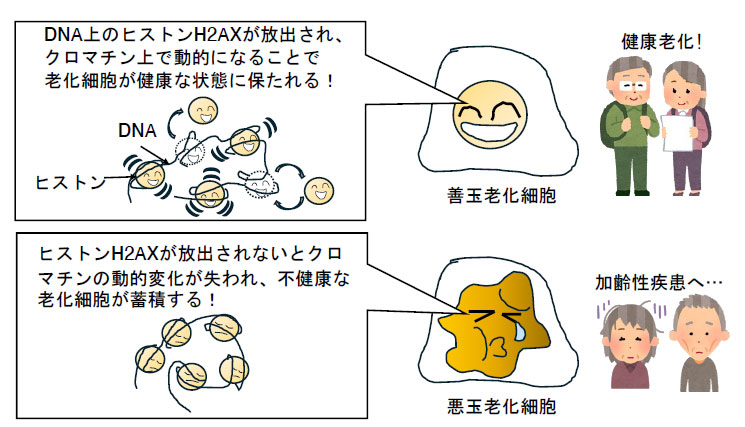
提供:井倉研究室
<関連情報>
- https://www.kyoto-u.ac.jp/ja/research-news/2026-01-08-1
- https://www.kyoto-u.ac.jp/sites/default/files/2026-01/web_2601_Ikura-62560dec0d99dd5b2a5ad22707b23e48.pdf
- https://www.tandfonline.com/doi/full/10.1080/10985549.2025.2596729
アセチル化依存的なヒストン H2AX の交換反応は、MDC1 の分解を介して病的⽼化 を抑制する Acetylation-Dependent Histone H2AX Exchange Suppresses Pathological Senescence via MDC1 Degradation
Masae Ikura,Kanji Furuya,Yasunori Horikoshi,Satoshi Tashiro,Takuma Shiraki&Tsuyoshi Ikura
Molecular and Cellular Biology Published:06 Jan 2026
DOI:https://doi.org/10.1080/10985549.2025.2596729
Abstract
Cellular senescence has a dual role in both tumor suppression and the promotion of age-related diseases. This paradox suggests the existence of functionally distinct “beneficial” and “detrimental” senescent states, yet the molecular basis that governs their fate has remained elusive. Here, we reveal that the dynamic exchange of histone H2AX on chromatin functions as an essential quality control mechanism that dictates the quality of senescence. We demonstrate that the histone acetyltransferase TIP60, in complex with the chaperone FACT, acetylates H2AX at lysine 5 (K5), which in turn drives its dynamic exchange. This histone exchange is indispensable for promoting the degradation of the DNA damage response mediator MDC1, a process we uncover is mediated by a novel DNA-PKcs-p97 signaling axis. Disruption of this TIP60-FACT-H2AX exchange pathway leads to the hyperaccumulation of MDC1 and a shift toward error-prone nonhomologous end joining (NHEJ), inducing a pathological senescent state with oncogenic potential. Our study redefines histone exchange from a passive chromatin event to an active regulatory hub that determines the fate of aging cells. These findings provide a molecular basis for the heterogeneity of senescence and establish a rationale for developing “senomorphic” therapies aimed at improving the quality of aging.