2026-01-08 コロンビア大学
<関連情報>
- https://news.columbia.edu/news/places-we-make-memories-help-us-inscribe-them
- https://www.nature.com/articles/s41562-025-02379-z
信頼できる神経表現を持つ空間コンテキストは、その後に配置されたオブジェクトの復元をサポートする Spatial contexts with reliable neural representations support reinstatement of subsequently placed objects
Rolando Masís-Obando,Kenneth A. Norman & Christopher Baldassano
Nature Human Behaviour Published:02 January 2026
DOI:https://doi.org/10.1038/s41562-025-02379-z
Abstract
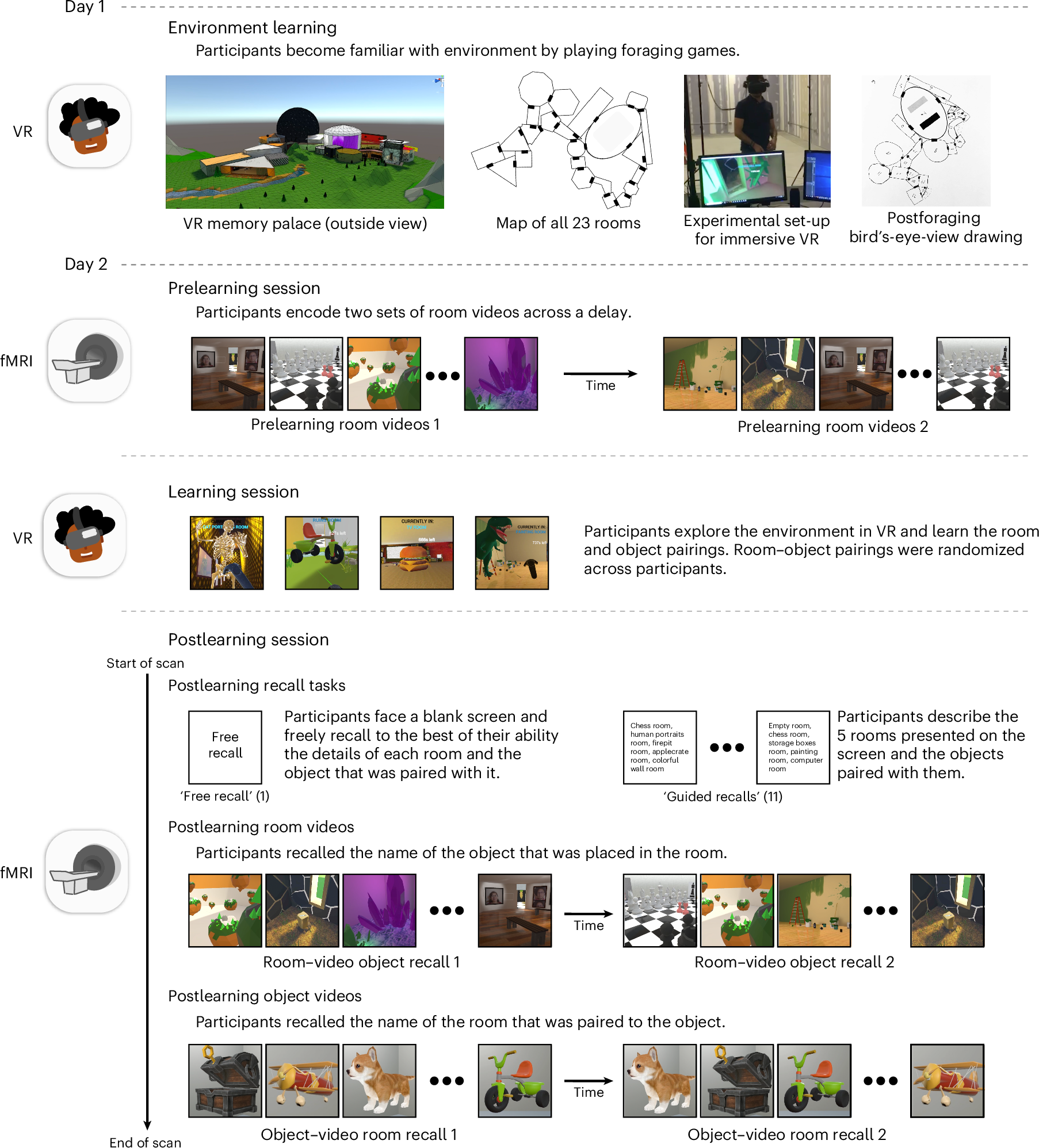
What are the neural properties that make spatial contexts effective scaffolds for storing and accessing memories? Here we hypothesized that spatial locations with stable and distinctive (that is, reliable) neural representations would best support memory for new experiences. To test this, participants learned the layout of a custom-built 23-room virtual reality ‘memory palace’ that they explored using a head-mounted display. The next day, participants underwent whole-brain fMRI while watching videos of the rooms, allowing us to measure the reliability of the neural activity pattern associated with each room. Participants then returned to virtual reality to encode 23 objects placed in each of the 23 rooms and later recalled the rooms and objects during fMRI. We found that our room reliability measure (computed before encoding) predicted object reinstatement during recall across cortex; this was driven not only by group-level reliability across participants but also by idiosyncratic reliability within participants. Moreover, this effect did not arise through enhanced retrieval of reliable rooms during recall, because the relationship between reliability and object reinstatement remained significant when controlling for room reinstatement during retrieval; this suggests that, instead, room reliability promotes improved binding of rooms to objects at encoding. Together, these results showcase how the quality of the neural representation of a spatial context can be quantified and used to ‘audit’ its utility as a memory scaffold for future experiences.