2026-01-09 京都大学
<関連情報>
- https://www.kyoto-u.ac.jp/ja/research-news/2026-01-09-1
- https://www.kyoto-u.ac.jp/sites/default/files/2026-01/web_2601_Mutou-fa5d6cccc5ea5a8b1bead05f546bbb9d.pdf
- https://www.thelancet.com/journals/eclinm/article/PIIS2589-5370(25)00623-6/fulltext
食道扁平上皮癌に対するニボルマブと根治的化学放射線療法(NOBEL):多施設共同単群第2相実現可能性試験 Nivolumab with definitive chemoradiotherapy for oesophageal squamous cell carcinoma (NOBEL): a multicentre, single-arm, phase 2 feasibility trial
Motoo Nomura ∙ Katsuyuki Sakanaka ∙ Juko Shimizu ∙ Shinya Ohashi ∙ Chikatoshi Katada ∙ Akinori Watanabe ∙ et al.
eClinicalMedicine Published:Published January 2, 2026
DOI:https://doi.org/10.1016/j.eclinm.2025.103689
Summary
Background
This single-arm, phase 2 trial investigated the safety, efficacy, and biomarkers associated with combining nivolumab, an immune checkpoint inhibitor, with definitive chemoradiotherapy in patients with operable or inoperable oesophageal squamous cell carcinoma (OSCC) because these have not been well established.
Methods
In this multicentre, single-arm, phase 2 feasibility trial, eligible patients (aged 20–75 years) with histologically confirmed OSCC, Eastern Cooperative Oncology Group performance status of 0–1, and adequate organ and bone marrow functions were enrolled from five Japanese institutions. The treatment involved concurrent chemoradiotherapy (cisplatin and 5-fluorouracil) with nivolumab, followed by maintenance nivolumab for up to 1 year. The primary endpoint was safety, defined as ≤10% incidence of grade ≥4 non-haematological toxicity and ≤15% incidence of grade ≥3 pneumonitis. Secondary endpoints included complete response, progression-free survival, and overall survival. Biomarker analyses of 51 immuno-related genes were performed on pretreatment biopsy specimens. This trial is registered in the Japan Registry of Clinical Trials, jRCT1091220408, and was terminated early due to slow patient enrolment.
Findings
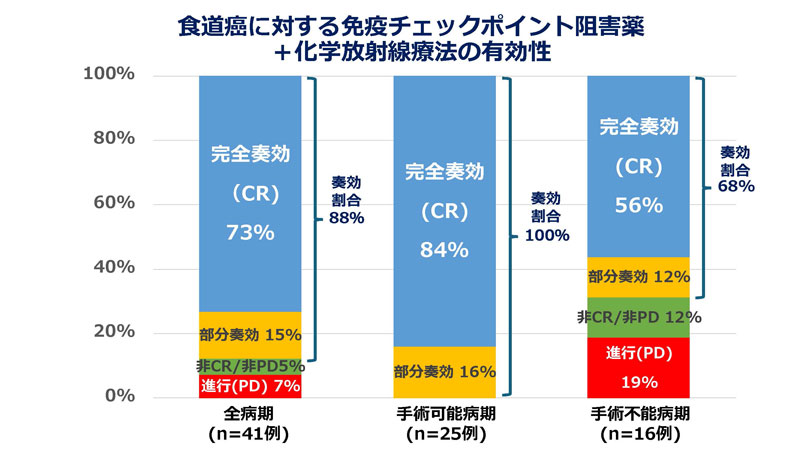
Between January 2019 and September 2021, 42 patients were enrolled and included in the safety analysis set, whereas 41 patients who received at least one post-baseline tumour assessment comprised the efficacy analysis set. The trial met its primary safety endpoint with only 5% of patients (2 of 41) experiencing grade 3 pneumonitis. The most common adverse events of were oesophagitis, constipation, and lymphopenia, and no treatment-related deaths occurred. 1-year overall survival was 92.7% (95% CI 79.0–97.6), and 1-year progression-free survival was 65.4% (95% CI 48.6–77.9). The overall complete response rate was 73% (30 of 41; 95% CI 58–84%). Exploratory biomarker analyses were conducted to investigate immune-related gene expression, but these findings should be regarded as hypothesis-generating.
Interpretation
Nivolumab combined with definitive chemoradiotherapy is feasible and showed acceptable toxicity in patients with OSCC. Further validation of exploratory biomarker findings is warranted in larger controlled studies.
Funding
Ono Pharmaceutical.