2026-01-12 インペリアル・カレッジ・ロンドン(ICL)
<関連情報>
- https://www.imperial.ac.uk/news/articles/natural-sciences/life-sciences/2025/new-research-explores-ecological-and-social-roots-of-same-sex-sexual-behaviour-in-primates-/
- https://www.nature.com/articles/s41559-025-02945-8
生態学的および社会的圧力が非ヒト霊長類における同性間の性行為を駆り立てる Ecological and social pressures drive same-sex sexual behaviour in non-human primates
Chloë Coxshall,Miles Nesbit,Josh Hodge & Vincent Savolainen
Nature Ecology & Evolution Published:12 January 2026
DOI:https://doi.org/10.1038/s41559-025-02945-8
Abstract
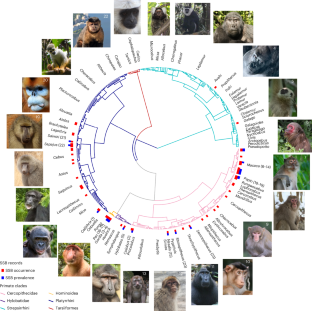
Same-sex sexual behaviour (SSB) is widespread across animal species; however, its evolutionary origins and ecological underpinnings remain poorly understood. In social animals, SSB is probably shaped by both genetic and environmental factors. For instance, a recent study in rhesus macaques indicates that while SSB is partially heritable and genetically based, it is also strongly influenced by environmental and social conditions. Here we compiled species-level data on 491 non-human primate species, documenting SSB occurrence and prevalence in 59 species, and examined its associations with 15 environmental, life history and social traits using phylogenetic regression and structural equation modelling. SSB occurrence was more likely in species inhabiting drier environments with increased food scarcity and predation pressure, in species with greater size dimorphism and longer lifespans and in those with more complex social structures and hierarchies. Structural equation modelling further indicated that environmental and life history traits influence SSB mainly indirectly, whereas social complexity directly promotes its occurrence. Together, these findings highlight SSB as a context-dependent behaviour shaped by interactions among ecological, life history and social factors, offering insights into the sexual diversity and social evolution of primates.