2026-01-15 パデュー大学
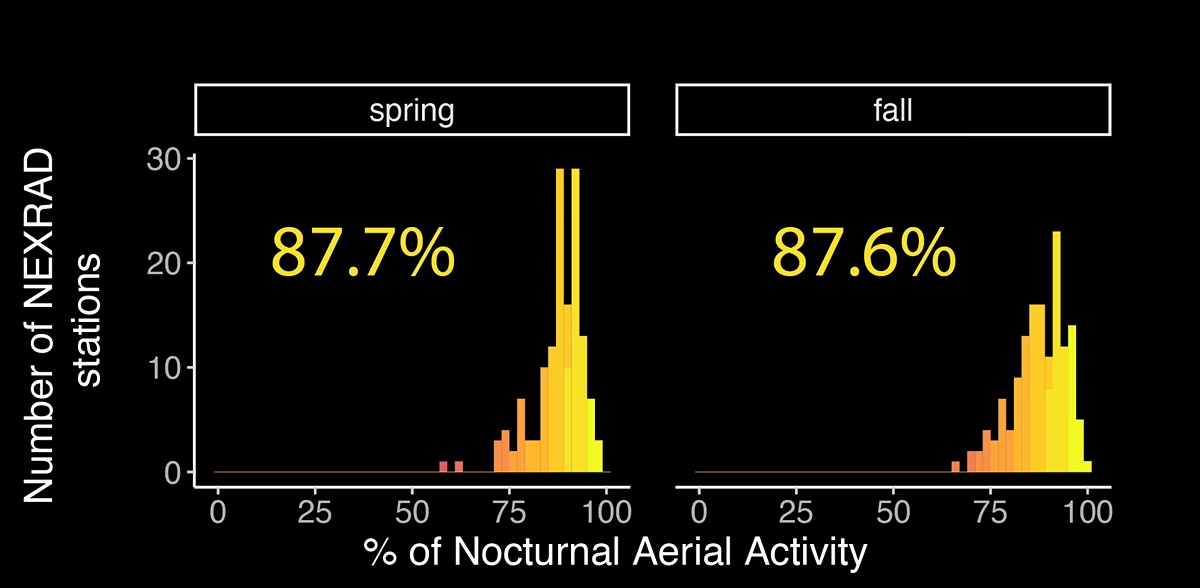
Percent of cumulative migration passage across spring (March 1–June 15), summer (June 16–July 31), and autumn (August 1–November 15) for nocturnal diel periods.
<関連情報>
- https://ag.purdue.edu/news/2026/01/research-uses-radar-to-expose-skys-organized-living-habitat.html
- https://esajournals.onlinelibrary.wiley.com/doi/10.1002/ecy.70247
空の構造化:下層大気における渡り動物の移動の日周ダイナミクス Structuring the skies: Diel dynamics of migratory animal movement in the lower atmosphere
Silvia Giuntini, Carolyn S. Burt, Annika L. Abbott, Carrie Ann Adams, Maria Carolina T. D. Belotti, Yuting Deng, Miguel F. Jimenez, Jeffrey F. Kelly, Subhransu Maji, Meredith Nash-Martin, Sam Simon, …
Ecology Published: 18 November 2025
DOI:https://doi.org/10.1002/ecy.70247
Abstract
Earth’s lower atmosphere is a vital ecological habitat, home to trillions of organisms that live, forage, and migrate through this medium. Despite its importance, this space is seldom considered a primary habitat for ecological or conservation prioritization, making it one of the least studied environments. However, it plays a crucial role as a global conduit for the transfer of biomass, weather, and inorganic materials. Fundamental research is essential to address core ecological questions related to the ecological consequences of this habitat’s intricate spatial and temporal structure. To advance our understanding of airspace use by migratory animals, we analyzed over 108 million 5-min radar observations from 143 NEXRAD sites, focusing on 24-h diel cycles across the contiguous United States. This extensive dataset, spanning from 1995 to 2022, allowed us to quantify aerial space use by systematically identifying peak activity times, the portion of the airspace that contained the majority of migration activity, and the percentage of migrants passing across diurnal and nocturnal diel cycles. We found that airspace is used predominantly during nocturnal periods in both spring and autumn (88%), while summer exhibited a more balanced distribution (54% nocturnal). Additionally, the percentage of nocturnal activity increased with latitude in spring and autumn but decreased in summer. Peak aerial activity typically occurred about 4 h after local sunset in both spring and autumn, with variations based on latitude and longitude. During these peak times, on average, half of the aerial movement was confined within a vertical band of 516 meters, starting around 355 m above ground level. Our research underscores the need to view the lower atmosphere as a structured habitat with significant ecological importance.