2026-01-21 ロックフェラー大学
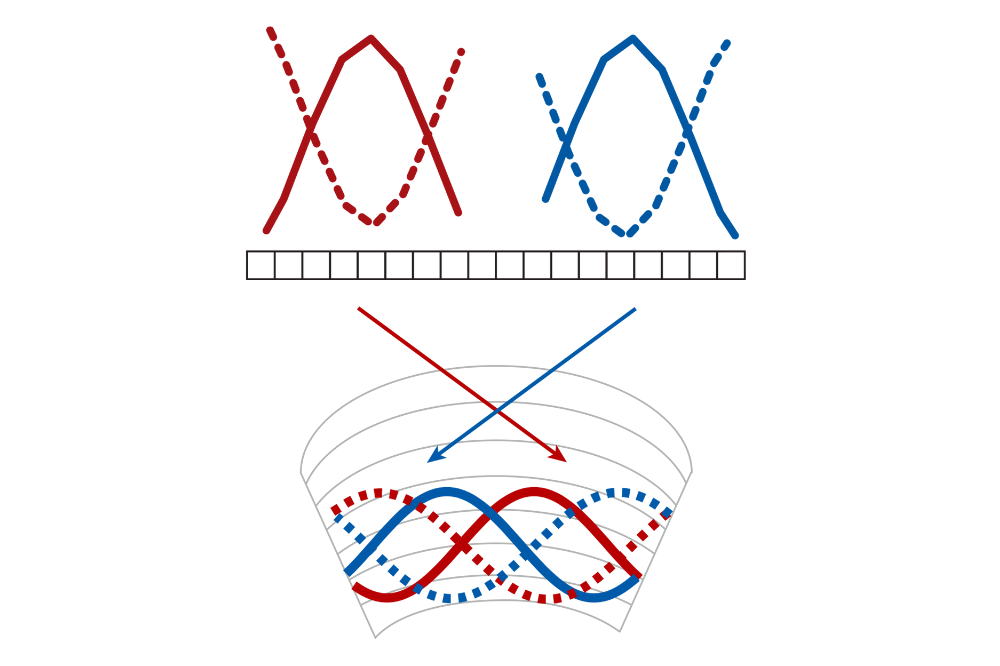
Figure illustrating how populations of neurons can invert vectors, encoded as sinusoids, using dual signaling capabilities. (Credit: Maimon lab)
<関連情報>
- https://www.rockefeller.edu/news/38928-study-on-brain-navigation-reveals-function-of-an-unconventional-electrical-signaling-mode-in-neurons/
- https://www.cell.com/cell/fulltext/S0092-8674(25)01375-3
神経カルシウムスパイクがショウジョウバエ脳におけるベクトル反転を可能にする Neuronal calcium spikes enable vector inversion in the Drosophila brain
Itzel G. Ishida ∙ Sachin Sethi ∙ Thomas L. Mohren ∙ Mia K. Haraguchi ∙ L.F. Abbott, ∙ Gaby Maimon
Cell Published:December 29, 2025
DOI:https://doi.org/10.1016/j.cell.2025.11.040
Highlights
- PFNa neurons signal 2D vectors via sinusoidal patterns of activity
- The PFNa vectors invert by aligning at either 0° or 180° relative to a compass signal
- PFNa cells emit T-type Ca2+ spikes when hyperpolarized to achieve vector inversion
- Ca2+ spikes, associated with mammalian sleep, serve a defined computational function
Summary
A typical neuron signals to downstream cells when it is depolarized and fires sodium spikes. Some neurons, however, also fire calcium spikes when hyperpolarized. The function of such bidirectional signaling remains unclear in most circuits. Here, we show how a neuron class that participates in vector computation in the fly central complex employs hyperpolarization-elicited calcium spikes to invert two-dimensional mathematical vectors. By switching from firing sodium to calcium spikes, these neurons implement a ∼180° realignment between the vector encoded in the neuronal population and the fly’s internal compass signal, thus inverting the vector. We show that calcium spikes rely on the T-type calcium channel Ca-α1T and argue via analytical and experimental approaches that these spikes enable vector computations in portions of angular space that would otherwise be inaccessible. These results reveal a seamless interaction between molecular, cellular, and circuit properties for implementing vector mathematics in the brain.