2026-01-27 京都大学
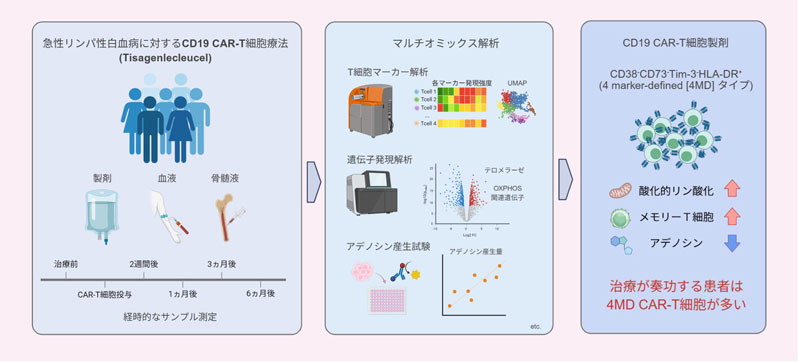
CD19 CAR-T細胞(tisagenlecleucel)を投与されたBCP-ALL患者のマルチオミックス解析の概要(BioRenderで作成。作者:三上貴司(https://BioRender.com/5zpwet9)、ライセンス: CC BY 4.0。)
<関連情報>
- https://www.kyoto-u.ac.jp/ja/research-news/2026-01-27
- https://www.kyoto-u.ac.jp/sites/default/files/2026-01/web_2601_Mikami-3acf52d7f7b45b921415eaf1f355fc69.pdf
- https://www.cell.com/cell-reports-medicine/fulltext/S2666-3791(25)00649-4
CD38–CD73 – Tim-3– HLA-DR+表現型を持つCAR-T細胞は、B細胞前駆細胞性急性リンパ芽球性白血病(ALL)の治療薬としてのチサゲンレクルセルの有効性を予測する CAR-T cells with the CD38–CD73–Tim-3–HLA-DR+ phenotype predict the efficacy of tisagenlecleucel as a treatment for B cell precursor ALL
Takashi Mikami ∙ Itaru Kato ∙ Mara Anais Llamas-Covarrubias ∙ … ∙ Akifumi Takaori-Kondo ∙ James Badger Wing ∙ Junko Takita
Cell Reports Medicine Published:January 23, 2026
DOI:https://doi.org/10.1016/j.xcrm.2025.102576
Highlights
- The CD38–CD73–Tim-3–HLA-DR+ (4MD) phenotype is important for the efficacy of tisa-cel
- Adenosine production via the CD38-CD73 axis is reduced in the 4MD CAR-T cells
- The 4MD CAR-T cells exhibit memory T cell features with high oxidative phosphorylation
Summary
Anti-CD19 chimeric antigen receptor T cell (CAR-T) therapy is highly effective for B cell precursor acute lymphoblastic leukemia (BCP-ALL); however, approximately half of the patients relapse. Thus, there is an urgent need to identify factors that improve efficacy. This study enrolls 19 patients with BCP-ALL (16 children and 3 young adults) who receive tisagenlecleucel. Infusion products, peripheral blood, and bone marrow samples are obtained before and after CAR-T cell infusion. Single-cell analysis reveals that central memory CARpos T cells increase in long-term responders, whereas CXCR3+CD38highPD-1high effector CARpos T cells are enriched in relapsed patients, post-infusion. By contrast, CARpos T cells obtained from infusion products in long-term responders are enriched in the CD38–CD73–Tim-3–HLA-DR+ phenotype, characterized by a decreased ability to produce adenosine, memory-like transcriptomic characteristics, and leveraging of mitochondrial metabolism and oxidative phosphorylation. Our study reveals that the CD38–CD73–Tim-3–HLA-DR+ phenotype contributes to long-term remission in patients with BCP-ALL who receive tisagenlecleucel.