
2026-01-30 東京科学大学
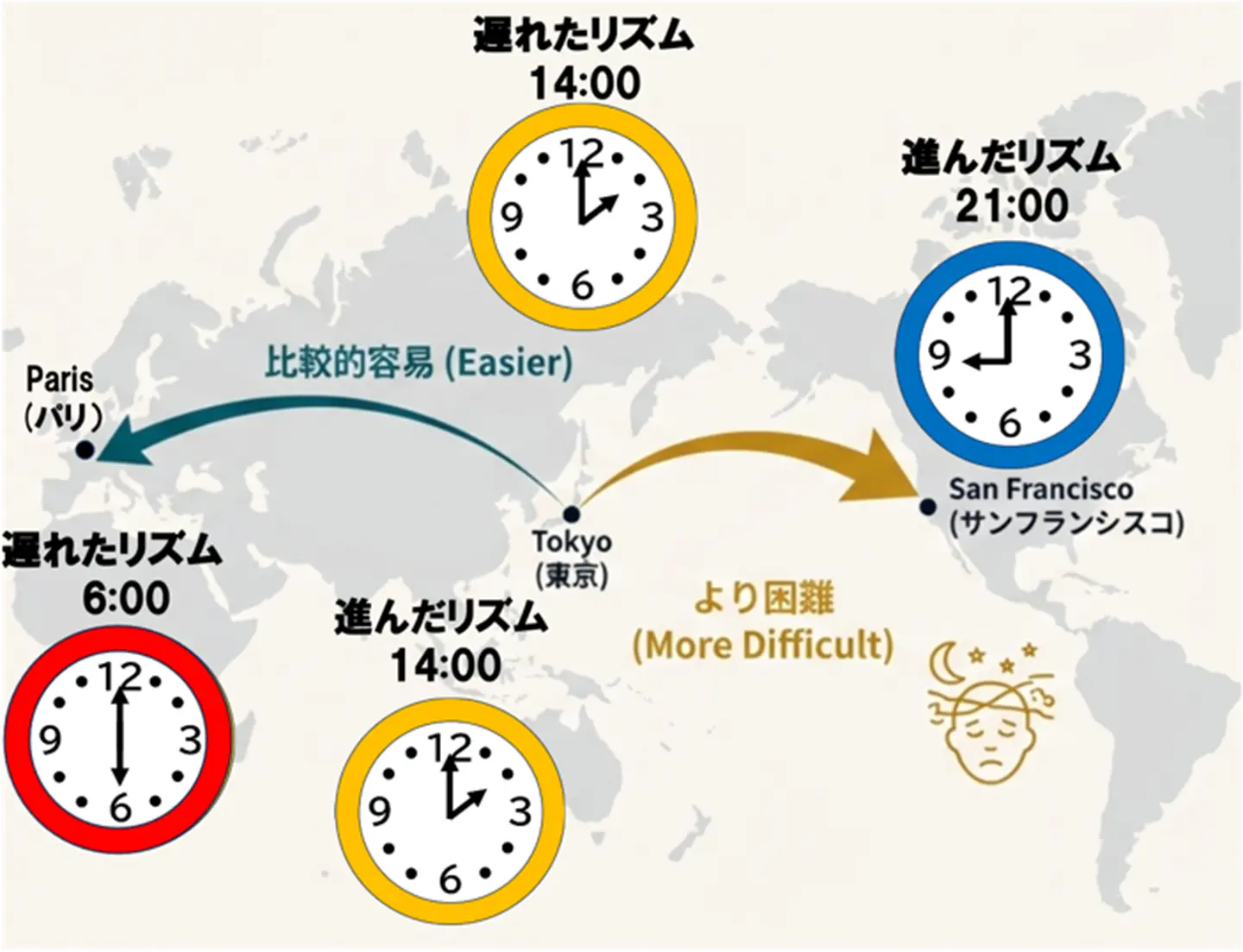
図1. 東向きと西向きフライトに伴う体内時計の位相前進と位相後退作用
<関連情報>
Period1 遺伝子の特異的誘導化合物はマウスの概日時計を前進させる A Period1 inducer specifically advances circadian clock in mice
Yoshifumi Takahata, Yuki Kasashima, Takuya Yoshioka, +23 , and Hajime Tei
Proceedings of the National Academy of Sciences Published:January 23, 2026
DOI:https://doi.org/10.1073/pnas.2509943123
Significance
Here, we reveal that Mic-628 specifically and sufficiently induces Per1, provoking an abrupt phase advance in mouse behavioral rhythms, regardless of the timing of administration. Disruption of tandem E-boxes in the mPer1 promoter abolishes most of both mPer1 induction and phase-advancing activity, highlighting their role as unique binding sites for the CLOCK–BMAL1 complex. Mass spectrometry identified CRY1 as a potential target, with Mic-628 enhancing CRY1 binding to CLOCK-BMAL1, which tightly correlates with Per1 induction. Moreover, the autonomous PER1-mediated feedback repression likely explains the consistent phase-advancing profile. Overall, Mic-628 exerts its distinctive effect through precise molecular interactions that unveil an additional layer of transcriptional control within the circadian clock. This makes Mic-628 a promising therapeutic candidate for circadian disruptions.
Abstract
West-to-east transmeridian flights are more disruptive than east-to-west ones due to challenges in advancing the human circadian clock. Transient mammalian Period1 (Per1) induction was predicted to predominantly advance the clock phase in our previous work. Here, we unravel a specific Per1 inducer, Mic-628, enabling abrupt phase advance in mouse behavioral rhythms, regardless of the timing of oral administration. Mic-628-treated mice re-entrain to phase-advanced light–dark cycles significantly faster. The direct interaction between Mic-628 and CRYPTOCHROME1 (CRY1) does not simply inhibit CRY1 repressor activity. Instead, the interaction facilitates the CLOCK-BMAL1 assembly, ensuring highly specific induction via a tandem E-box motif upstream of the Per1 promoter. Importantly, Mic-628-driven Per1 induction is repressed by PER1 itself. Mathematical modeling indicates that both the CRY1- and PER1-mediated transcriptional regulation fix the phase of Per1 induction irrespective of intake time, thereby predominantly advancing the clock phase. These findings underscore the potential of selective Per expression as a therapeutic approach for human circadian rhythm disorders.
