
2026-02-06 東北大学
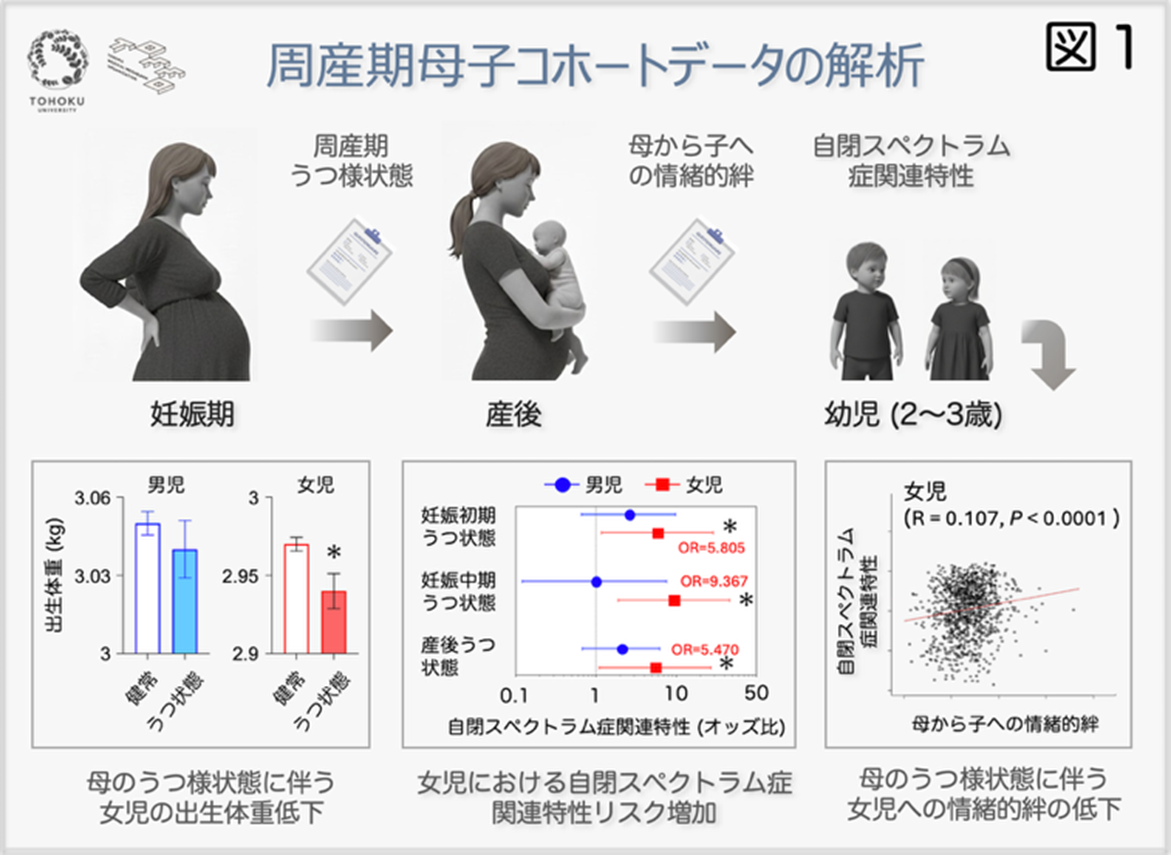
図1. 三世代コホート調査のデータを利用した研究の詳細
母親の周産期うつ症状の指標は、女児における出生時体重の低下 (P = 0.01)、妊娠初期から産後にかけて女児の自閉スペクトラム症関連特性の指標と有意に関連していました(オッズ比: 5.805-9.367; P < 0.05)。母親の産後うつ状態を示す指標と生まれた女児との情緒的な絆の低下を示す指標との間に弱い関連性が認められました(相関係数= 0.107, P < 0.0001)。
<関連情報>
- https://www.tohoku.ac.jp/japanese/2026/02/press20260206-02-cohort.html
- https://www.tohoku.ac.jp/japanese/newimg/pressimg/tohokuuniv-press20260206_web02_cohort.pdf
- https://www.nature.com/articles/s41380-026-03456-z
周産期うつ病が幼児の自閉スペクトラム症関連特性リスクに及ぼす性差: コホート調査とマウス研究 Sex differences in the risk of autistic-related traits in toddlers born to mothers with perinatal depression: Evidence from human cohort and mouse study
Changrong Duan,Zhiqian Yu,Xue Li,Mai Sakai,Yuko Maejima,Kenju Shimomura,Tomoyuki Furuyashiki,Saya Kikuchi,Natsuko Kobayashi,Kazuto Sasaki,Tasuku Matsuki,Hiroshi Komatsu,Mizuki Hino,Yasuto Kunii,Tomoko Kasahara,Mami Ishikuro,Keiko Murakami,Masatsugu Orui,Takaaki Abe,Fuji Nagami,Nobuo Fuse,Soichi Ogishima,Kengo Kinoshita,Masayuki Yamamoto,… Hiroaki Tomita
Molecular Psychiatry Published:04 February 2026
DOI:https://doi.org/10.1038/s41380-026-03456-z
Abstract
Maternal perinatal depression (MPD) is associated with reduced maternal plasma oxytocin (OXT) levels and an increased risk of autism spectrum disorder (ASD) in offspring. Using data from 23,218 Japanese mother–child pairs, we evaluated the relationship between MPD—assessed with the Kessler Psychological Distress Scale (K6) and the Edinburgh Postnatal Depression Scale (EPDS)—and autistic-related traits (ART) in toddlers, measured by the Tokyo Autistic Behavior Scale (TABS). We also tested the potential causal relationship of maternal stress exposure on OXT, its receptor (OXTR), and offspring outcomes using a prenatal stress-exposed mouse model. In the human cohort study, higher K6 or EPDS scores during pregnancy and postpartum were significantly associated with increased TABS scores in toddlers. Offspring of mothers with MPD (K6 or EPDS score ≥ 9) during pregnancy or postpartum exhibited a higher risk of ART (TABS score ≥ 15; P < 0.05). This risk was particularly pronounced in female toddlers exposed to MPD during pregnancy and postpartum (ORs: 5.805–9.367; P < 0.05). Female toddlers born to mothers with MPD also had lower birth weight, and their ART were positively correlated with K6 scores during mid-gestation and with impaired maternal bonding postpartum. In the mouse model, chronically stressed dams displayed depressive-like behaviors, and their female juveniles exhibited increased self-grooming and impaired social interaction. Furthermore, OXTR mRNA levels were significantly reduced in the prefrontal cortex of female juveniles from stressed dams. These findings suggest that MPD increases the risk of ART, particularly in females, highlighting potential sex-specific mechanisms underlying ASD susceptibility.

