
2025-02-10 名古屋大学,科学技術振興機構
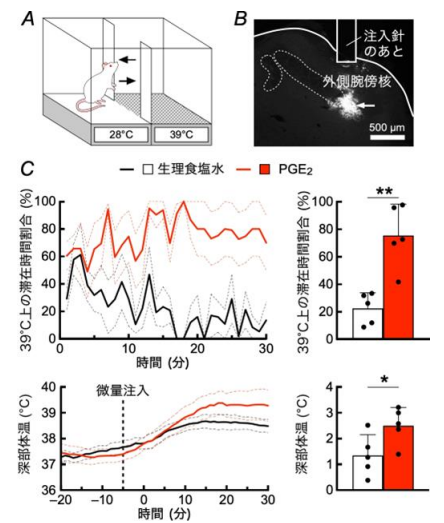
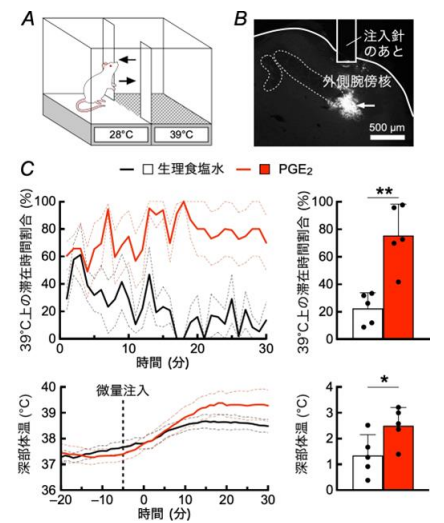
図1: 外側腕傍核への PGE₂投与が暑熱欲求行動を誘導する (A) 2 プレート温度選択試験(28°C:中性温と 39°C:高温に設定)。 (B) 外側腕傍核への PGE₂の微量投与。外側腕傍核の組織断面を示す。実験後に蛍光ビーズを注入して薬物投与部位を標識した(矢印)。 (C) 生理食塩水あるいは PGE₂の微量投与から 5 分後に 2 プレート温度選択試験を行った(時間軸 0〜30 分の間)。
<関連情報>
- https://www.jst.go.jp/pr/announce/20260210/index.html
- https://www.jst.go.jp/pr/announce/20260210/pdf/20260210.pdf
- https://physoc.onlinelibrary.wiley.com/doi/10.1113/JP289466
発熱性メディエーターであるプロスタグランジンE2は、EP3受容体を発現する傍腕核ニューロンを介して温熱欲求を誘発する:悪寒の潜在的メカニズム The pyrogenic mediator prostaglandin E2 elicits warmth seeking via EP3 receptor-expressing parabrachial neurons: a potential mechanism of chills
Takaki Yahiro, Yoshiko Nakamura, Kazuhiro Nakamura
The Journal of Physiology published: 10 February 2026
DOI:https://doi.org/10.1113/JP289466

Abstract
Seeking warmth during infection is a sickness behaviour that contributes to the development of fever and is often accompanied by chills. However, the central mechanism underlying this behaviour remains unknown. We recently reported two ascending thermosensory neuronal pathways from the lateral parabrachial nucleus (LPB) of the pons that drive thermoregulatory behaviours in hot and cold environments: one pathway to the preoptic area (POA), a thermoregulatory centre, mediates heat avoidance, whereas the other to the central amygdaloid nucleus (CeA), a limbic emotion centre, mediates cold avoidance. Here we investigated the role of prostaglandin E2 (PGE2), a pyrogenic mediator produced during infection, in the LPB-mediated mechanism of thermoregulatory behaviour in rats. Thermal preference tests and in vivo physiological recordings revealed that PGE2 acting on the prostaglandin EP3 receptor (EP3R) in the LPB elicits behaviour that prefers warmth to a thermoneutral temperature, thereby contributing to an increase in body core temperature. However, it does not elicit brown adipose tissue thermogenesis, an autonomic febrile response. Notably, we discovered that EP3R-expressing LPB neurons (LPBEP3R neurons) project numerous axons to the CeA, but few to the POA. Functional neuronal tracing combined with immunostaining of Fos, a marker for neuronal activation, revealed that LPBEP3R→CeA neurons are activated by cold ambient temperature and constitute the majority of the cold-transmitting LPB→CeA neuronal population mediating cold avoidance. These results indicate that PGE2 action on LPBEP3R neurons during infection elicits warmth-seeking behaviour by augmenting their cold sensory transmission to the CeA, which potentially produces the unpleasant cold sensation of chills.
Key points
- Seeking warmth during infection is a commonly observed sickness behaviour that contributes to the development of fever, often accompanied by chills.
- Prostaglandin E2 (PGE2), a pyrogenic mediator, elicits warmth-seeking behaviour in rats by acting on prostaglandin EP3 receptor (EP3R)-expressing neurons in the lateral parabrachial nucleus (LPB) of the pons (LPBEP3R neurons).
- This PGE2 action does not elicit thermogenesis in brown adipose tissue, an autonomic febrile response.
- LPBEP3R neurons transmit cutaneous cold sensory signals to the limbic emotion centre, central amygdaloid nucleus (CeA), but scarcely innervate the thermoregulatory centre, preoptic area.
- These results indicate that PGE2 acting on LPBEP3R neurons during infection elicits warmth-seeking behaviour by augmenting cold sensory transmission to the CeA, which is a potential mechanism of chills.

