2026-03-04 ワシントン大学セントルイス校
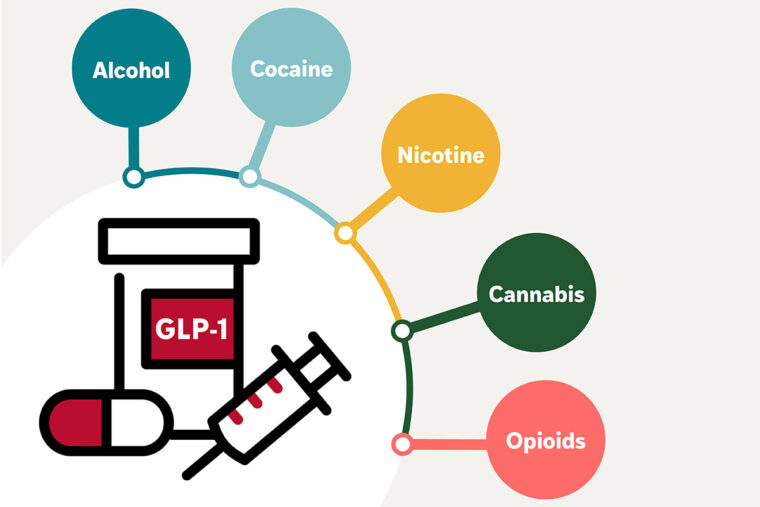
WashU Medicine researchers find in a new study that GLP-1 use is tied to reductions in substance use disorders and serious outcomes across all types of addictive substances. (Image: Sara Moser/WashU Medicine)
<関連情報>
- https://source.washu.edu/2026/03/glp-1-medications-get-at-the-heart-of-addiction-study/
- https://medicine.washu.edu/news/glp-1-medications-get-at-the-heart-of-addiction-study/
- https://www.bmj.com/content/392/bmj-2025-086886
グルカゴン様ペプチド-1受容体作動薬と2型糖尿病を患う米国退役軍人における物質使用障害リスク:コホート研究 Glucagon-like peptide-1 receptor agonists and risk of substance use disorders among US veterans with type 2 diabetes: cohort study
Miao Cai, biostatistician;Taeyoung Choi, biostatistician;Yan Xie, director of pharmacoepidemiology;Ziyad Al-Aly, director
The BMJ Published: 04 March 2026
DOI:https://doi.org/10.1136/bmj-2025-086886
Abstract
Objectives To investigate whether initiation of glucagon-like peptide-1 (GLP-1) receptor agonists is associated with both reduced risks of incident alcohol, cannabis, cocaine, nicotine, opioid, and other substance use disorders (SUDs) in people with no history of SUDs (protocol 1) and with reduced risk of SUD related adverse clinical outcomes among people with a pre-existing SUD (protocol 2).
Design Emulation of eight parallel, new user, active comparator target trials using electronic health records: seven trials for each incident SUD outcome (protocol 1) and one trial for adverse outcomes in people with pre-existing SUD (protocol 2).
Setting US Department of Veterans Affairs.
Participants From a base population of 606 434 US veterans with type 2 diabetes, participants were assigned to one of the two protocols and followed for up to three years. Trial 1 (primary trial) of protocol 1 included 524 817 initiators of GLP-1 receptor agonists (n=124 001) or sodium-glucose cotransporter-2 (SGLT-2) inhibitors (n=400 816). Protocol 2 included 81 617 initiators of GLP-1 receptor agonists (n=16 768) and SGLT-2 inhibitors (n=64 849).
Main outcome measures Incident outcomes were alcohol, cannabis, cocaine, nicotine, opioid, other SUDs, and a composite of these outcomes. Adverse outcomes among participants with pre-existing SUDs included SUD related emergency department visits, SUD related hospital admissions, and SUD related mortality, and drug overdose and suicidal ideation or attempt. Hazard ratios and net three year risk difference (NRD) per 1000 people were reported based on inverse probability weighted (standardised mortality ratio weighted) cause specific Cox survival models.
Results Compared with initiation of SGLT-2 inhibitors, initiation of GLP-1 receptor agonists was associated with reduced risk of disorders related to alcohol use (hazard ratio 0.82 (95% confidence interval (CI) 0.78 to 0.85); NRD per 1000 people −5.57 (−6.61 to −4.53)), cannabis use (0.86 (0.81 to 0.90), NRD −2.25 (−3.00 to −1.50)), cocaine use (0.80 (0.72 to 0.88), NRD −0.97 (−1.37 to −0.57)), nicotine use (0.80 (0.74 to 0.87), NRD −1.64 (−2.19 to −1.09)), and opioid use (0.75 (0.67 to 0.85), NRD −0.86 (−1.19 to −0.52)), and other SUDs (0.87 (0.81 to 0.94), NRD −1.12 (−1.68 to −0.55)) and composite outcome of all incident SUDs (0.86 (0.83 to 0.88), NRD −6.61 (−7.95 to −5.26)). Among people with pre-existing SUDs, initiation of GLP-1 receptor agonists was associated with reduced risk of SUD related emergency department visits (0.69 (0.61 to 0.78), NRD −8.92 (−11.59 to −6.25)), SUD related hospital admissions (0.74 (0.65 to 0.85), NRD −6.23 (−8.73 to −3.74)), and SUD related mortality (0.50 (0.32 to 0.79), NRD −1.52 (−2.32 to −0.72)), and drug overdose (0.61 (0.42 to 0.88), NRD −1.49 (−2.43 to −0.55)) and suicidal ideation or attempt (0.75 (0.67 to 0.83), NRD −9.95 (−13.14 to −6.77)). Analyses of treatment adherence showed directionally consistent results with analyses of treatment initiation for both incident SUDs and adverse outcomes among participants with pre-existing SUDs.
Conclusions Use of GLP-1 receptor agonists was consistently associated with reduced risks of developing various incident SUDs, suggesting a broad preventive effect across multiple substance types. Use was also associated with reduced risks of adverse clinical outcomes in people with pre-existing SUDs. These observational data suggest a potential role for GLP-1 receptor agonists in both the prevention and the treatment of various SUDs, warranting further evaluation.