2026-03-10 インペリアル・カレッジ・ロンドン(ICL)
<関連情報>
- https://www.imperial.ac.uk/news/articles/global-health-innovation/2026/new-research-conducted-using-google-ai-can-match-or-exceed-radiologists-in-detecting-cancer-in-breast-scans-/
- https://www.nature.com/articles/s43018-026-01127-0
- https://www.nature.com/articles/s43018-026-01128-z
乳がん検診におけるAIの診断精度、公平性、臨床実装:多施設共同の後ろ向きおよび前向きの技術的実現可能性研究の結果 Diagnostic accuracy, fairness and clinical implementation of AI for breast cancer screening: results of multicenter retrospective and prospective technical feasibility studies
Christopher J. Kelly,Marc Wilson,Lucy M. Warren,Richard Sidebottom,Mark Halling-Brown,Lin Yang,Megumi Morigami,Jenny Venton,Reena Chopra,Jane Chang,Jonathan Dixon,Fiona J. Gilbert,Daniel I. Golden,Elzbieta Gruzewska,Lesley Honeyfield,Amandeep Hujan,Delara Khodabakhshi,Emma Lewis,Namrata Malhotra,Rachita Mallya,Della Ogunleye,Charlotte Purdy,Rory Sayres,Marcin Sieniek,… Deborah Cunningham
Nature Cancer Published:10 March 2026
DOI:https://doi.org/10.1038/s43018-026-01127-0
Abstract
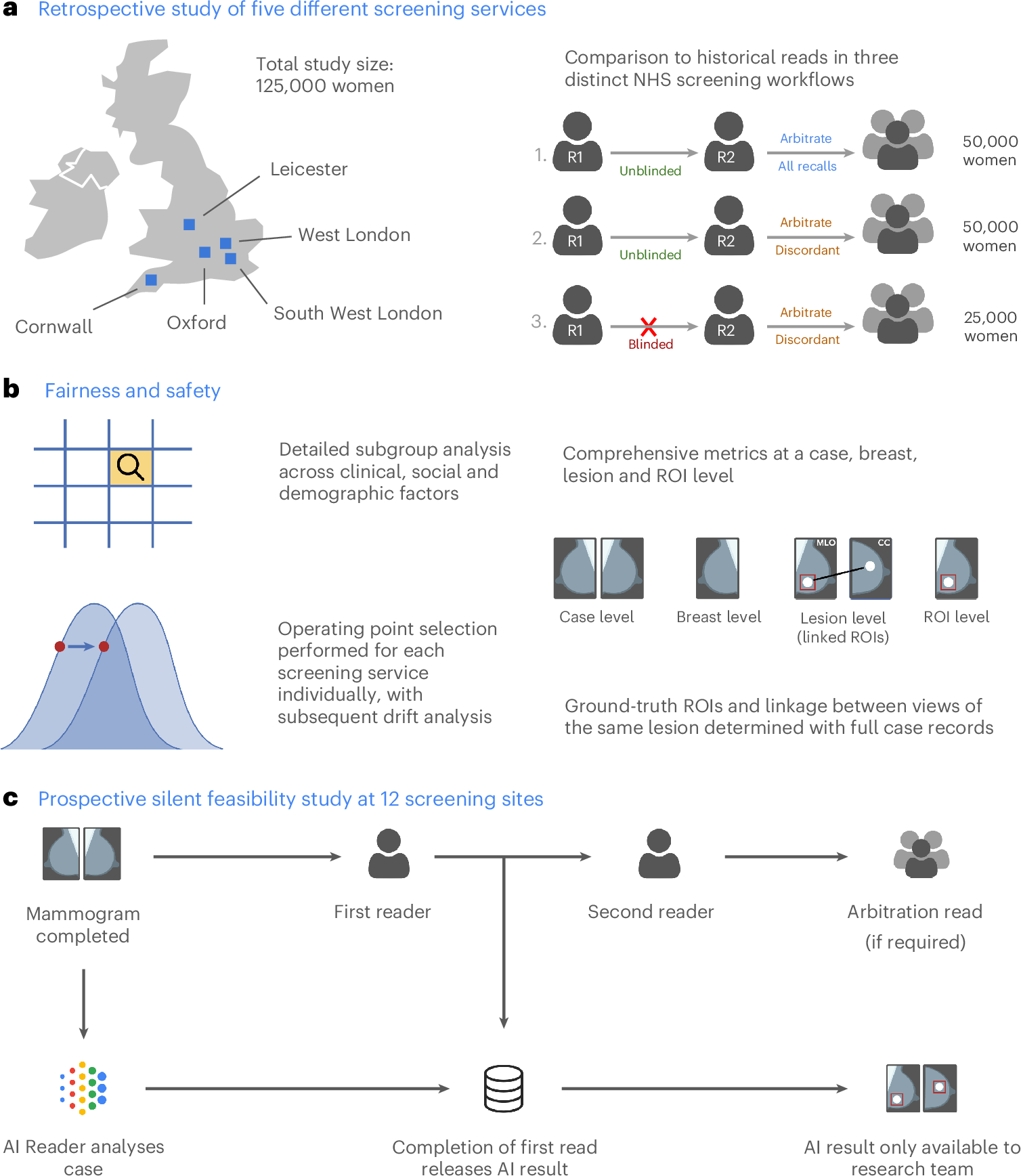
Artificial intelligence (AI) promises to enhance breast cancer screening. Here we evaluated Google’s mammography AI system (version 1.2) across two phases: a retrospective study using 115,973 mammograms from five National Health Service screening services with 39-month follow-up and prospective noninterventional feasibility deployment at 12 sites (9,266 cases). The primary endpoint was AI sensitivity and specificity versus first reader using a 5% noninferiority margin. The secondary endpoints were performance versus second or consensus readers and breast-level analyses. Retrospectively, AI achieved superior sensitivity (0.541 versus 0.437 for first reader, P < 0.001) and noninferior specificity (0.943 versus 0.952, P < 0.001). Cancer detection rate increased from 7.54 to 9.33 per 1,000 women, with AI detecting 25.0% of interval cancers. Performance was particularly strong for first screens (39.3% fewer recalls, 8.8% higher detection) and invasive cancers. No systematic demographic disparities were observed. Simulated second-reader replacement reduced reading time by 32% while increasing detection by 17.7%. Prospective deployment confirmed technical feasibility but revealed a distribution shift requiring threshold recalibration. Implementation requires adaptive calibration and continuous monitoring to ensure safety and equity.
乳がん検診における第2読影者としての人工知能の利用の影響(仲裁を含む) Impact of using artificial intelligence as a second reader in breast screening including arbitration
Lucy M. Warren,Jenny Venton,Kenneth C. Young,Mark Halling-Brown,Christopher J. Kelly,Marc Wilson,Megumi Morigami,Lisanne Khoo,Deborah Cunningham,Richard Sidebottom,Mamatha Reddy,Hema Purushothaman,Delara Khodabakhshi,Lesley Honeyfield,Amandeep Hujan,Tsvetina Stoycheva,Andy Joiner,Reena Chopra,Aminata Sy,Dominic Ward,Lin Yang,Rory Sayres,Daniel Golden,Namrata Malhotra,… Hutan Ashrafian
Nature Cancer Published:10 March 2026
DOI:https://doi.org/10.1038/s43018-026-01128-z
Abstract
The impact of incorporating artificial intelligence (AI) into a double-read breast-screening workflow, including arbitration, is unclear. This retrospective study included 50,000 representative women from two NHS breast-screening centers. All the women had long-term follow-up, allowing us to determine whether use of AI leads to earlier cancer detection. Cases requiring arbitration (8,732 cases) were read by 22 readers in a reader study, following their normal arbitration workflow. Overall, after arbitration, replacing the second reader with AI was noninferior (5% margin) to two human readers in terms of sensitivity and specificity (P < 0.001) while offering a workload benefit. Arbitration improved the specificity of the AI arm by overruling cases incorrectly recalled by the AI tool; however, it also overruled the AI tool recall decision for some interval and next-round cancers. Further development of the AI tool alongside improvement in its explainability could lead to the earlier detection of cancers.