2026-03-11 東北大学
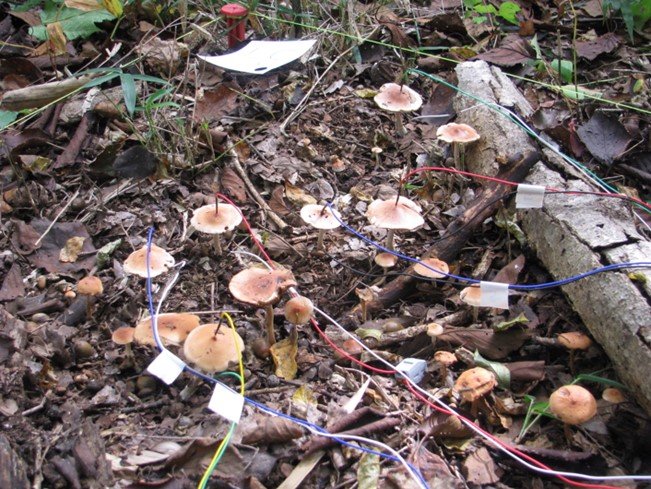
図1. キノコに設置された電極
<関連情報>
- https://www.tohoku.ac.jp/japanese/2026/03/press20260311-02-fungi.html
- https://www.tohoku.ac.jp/japanese/newimg/pressimg/tohokuuniv-press20260311_02_fungi.pdf
- https://www.nature.com/articles/s41598-026-42673-y
野外における2種類の外生菌根菌の胞子嚢果を流れる電気情報 Electrical information flows across the sporocarps of two ectomycorrhizal fungi in the field
Yu Fukasawa,Daisuke Akai,Takayuki Takehi,Daiki Takahashi & Yutaka Osada
Scientific reports Published:06 March 2026
DOI:https://doi.org/10.1038/s41598-026-42673-y Unedited version
Abstract
Electrical signal transfer across fungal mycelia in forest floor is a fascinating idea in ecology but not fully explored yet. We measured the extracellular bioelectrical activities of two ectomycorrhizal basidiomycete species belonging to the genus Hebeloma in a field to examine the potential information flow across the sporocarps and its reponse to artificial stimulation. The 37 sporocarps (29 H. danicum and 8 H. cylindrosporum) occurring within a 5 m × 5 m quadrat on the forest floor of an oak-dominated stand were measured for their electrical potential every second for 3.5 days using subdermal stainless electrodes. Causality analysis of electrical potential during a period without artificial stimulation indicated that the magnitude of potential information flow across the sporocarps was not restricted to the sporocarps belonging to the same genet (clone) nor within a species. However, this was still negatively associated with genetic as well as spatial distances. Local addition of tap water to the base of a certain sporocarp significantly increased the average magnitude of information flow across the sporocarps, whereas the global addition of tap water to all the sporocarps greatly reduced the information flow. The addition of urine had minimal effect on the magnitude of information flow. These results indicate the presence of underground electrical information flows across fungal sporocarps which respond vigorously to the environmental conditions.