
2026-03-11 ブラウン大学
<関連情報>
- https://www.brown.edu/news/2026-03-11/spinal-cord-stimulation
- https://www.nature.com/articles/s41551-026-01627-5
脊髄損傷者の感覚運動機能は、損傷周囲の神経調節によって回復する Perilesional neuromodulation replaces lost sensorimotor function in persons with spinal cord injury
Jonathan S. Calvert,Samuel R. Parker,Lakshmi N. Govindarajan,Radu Darie,Elias Shaaya,Ryan Solinsky,Lily M. Del Valle,Priyanka Miranda,Jaeson Jang,Ekta Tiwari,Sohail Syed,Raymond M. Villalobos,Liza M. Aguiar,J. Andrew Taylor,Hanlin Tang,Sean McPherson,Wenzhe Xue,Alexios G. Carayannopoulos,Adetokunbo A. Oyelese,Ziya L. Gokaslan,Arjun K. Bansal,Linda J. Resnik,Thomas Serre,Jared S. Fridley & David A. Borton
Nature Biomedical Engineering Published:11 March 2026
DOI:https://doi.org/10.1038/s41551-026-01627-5
Abstract
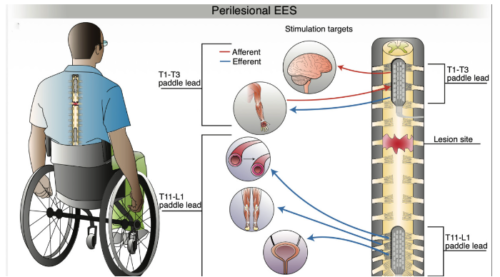
Spinal cord injury (SCI) results in permanent impairment of sensory, motor and autonomic function. Epidural electrical stimulation (EES) applied below the lesion can restore voluntary movement, autonomic function and locomotion following chronic SCI. However, impaired sensation below the SCI does not improve during the application of sublesional EES. Here we present first-in-human results demonstrating simultaneous lower extremity motor activation and somatosensory feedback in three participants with motor complete, chronic SCI enabled by perilesional EES. We determined motor- and sensory-specific EES parameters by leveraging modern deep learning methods and participant-directed control of stimulation. Supralesional EES evoked sensations were synchronized with leg movement, enabling participants to accurately report leg position. We then applied simultaneous supralesional and sublesional EES, enabling intentional control over leg movements and somatosensory feedback during functional tasks. Overall, we demonstrate a perilesional EES framework to modulate sensorimotor function that may improve quality of life in individuals with SCI.

