2026-03-16 エディンバラ大学
<関連情報>
- https://www.ed.ac.uk/news/waste-plastic-turned-into-parkinsons-drug
- https://www.nature.com/articles/s41893-026-01785-z
プラスチック廃棄物を微生物によってレボドパにアップサイクルする Microbial upcycling of plastic waste to levodopa
Benjamin Royer,Yuta Era,Marcos Valenzuela-Ortega,Thomas W. Thorpe,Connor L. Trotter,Kitty Clouston,John F. C. Steele,Nicoll Zeballos,Eugene Shrimpton-Phoenix,Bhumrapee Eiamthong,Chayasith Uttamapinant,Christopher W. Wood & Stephen Wallace
Wood & Stephen Wallace Published:16 March 2026
DOI:https://doi.org/10.1038/s41893-026-01785-z
Abstract
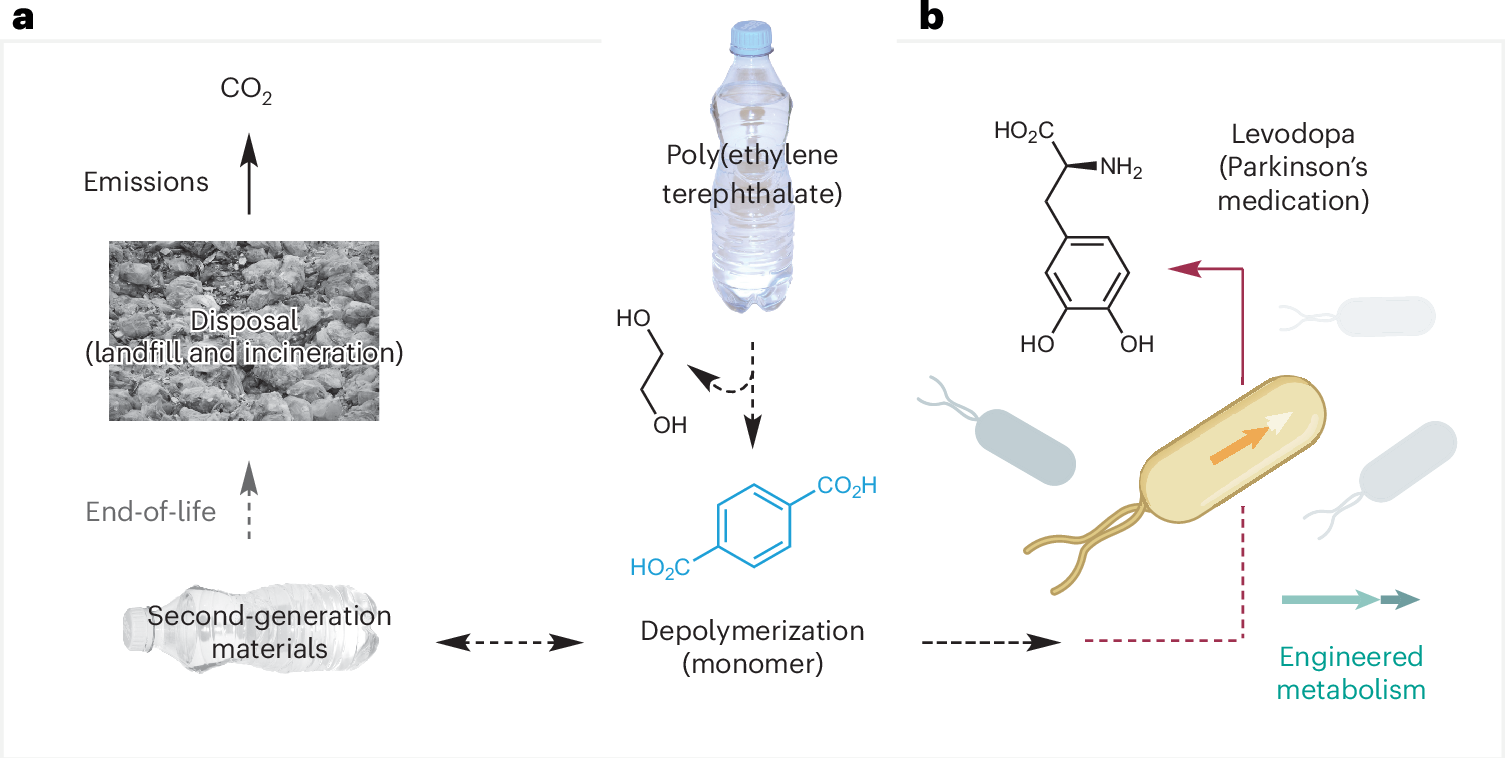
Using engineering biology to perform complex chemical synthesis offers a sustainable alternative to traditional processes that rely on finite fossil resources. A growing opportunity within this field lies in reclaiming carbon embedded in industrial and post-consumer waste—carbon otherwise lost to landfill, incineration or pollution. Here we report the bio-upcycling of poly(ethylene terephthalate) (PET) plastic waste into levodopa (l-DOPA), a frontline medication for Parkinson’s disease, using engineered Escherichia coli. Two key bottlenecks—substrate import and feedback inhibition by the intermediate protocatechuate—were addressed through heterologous transporter expression and functional pathway separation across two microbial strains. To further improve sustainability, and as a proof-of-concept, Chlamydomonas reinhardtii was used to capture CO2 released during catechol generation. The resulting bioprocess operates under mild, aqueous conditions and achieves high l-DOPA titres (5.0 g l−1), with isolated product obtained at preparative scale from both industrial PET waste and a single post-consumer plastic bottle. This work demonstrates how engineering biology can transform plastic-derived aromatic monomers into high-value pharmaceuticals for the treatment of neurological disease in humans.