
2026-03-26 ゲーテ大学
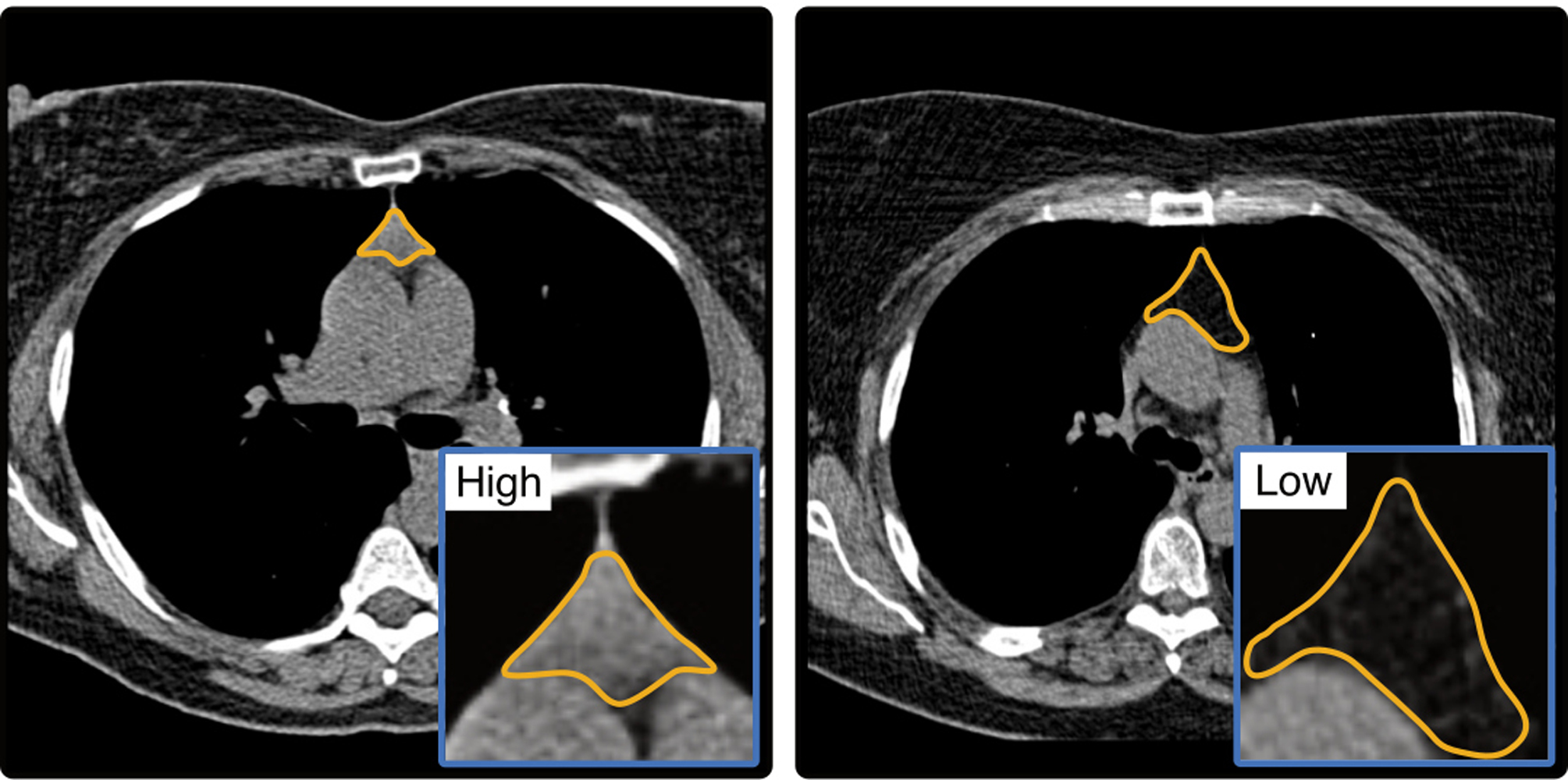
Thymus health may differ: CT scan of a more healthy (left) and less healthy (right) thymus. Photo: Bernatz et al., Nature (2026), https://doi.org/10.1038/s41586-026-10243-x
<関連情報>
- https://aktuelles.uni-frankfurt.de/english/the-underestimated-thymus-new-studies-reveal-its-relevance-for-healthy-aging/
- https://www.nature.com/articles/s41586-026-10242-y
- https://www.nature.com/articles/s41586-026-10243-x
成人における胸腺の健康への影響 Thymic health consequences in adults
Simon Bernatz,Vasco Prudente,Suraj Pai,Asbjørn K. Attermann,Yumeng Cao,Jiachen Chen,Asya Lyass,Borek Foldyna,Leonard Nürnberg,Keno Bressem,Christopher Abbosh,Charles Swanton,Mariam Jamal-Hanjani,Michael T. Lu,Joanne M. Murabito,Kathryn L. Lunetta,Nicolai J. Birkbak & Hugo J. W. L. Aerts
Nature Published:18 March 2026
DOI:https://doi.org/10.1038/s41586-026-10242-y
Abstract
The thymus is essential for establishing T cell diversity early in life, but undergoes profound involution with age and has therefore traditionally been regarded as largely nonfunctional in adults1,2. Here we propose that preserving thymic functionality is integral to adult health and longevity. We developed a deep learning framework to quantify thymic health from routine radiographic images and evaluated its association with longevity and risk of major age-associated diseases in two large prospective cohorts of asymptomatic adults: the National Lung Screening Trial (n = 25,031) and the Framingham Heart Study (n = 2,581). In both cohorts, thymic health varied markedly across the population. In the National Lung Screening Trial, higher thymic health was consistently associated with lower all-cause mortality, reduced lung cancer incidence and lower cardiovascular mortality over 12 years of follow-up after adjustment for age, sex, smoking and comorbidities. In the independent Framingham Heart Study cohort, higher thymic health was significantly associated with reduced cardiovascular mortality, independent of age, sex and smoking. Thymic health was further linked to systemic inflammation and metabolic dysregulation, and associated with modifiable lifestyle factors including smoking, obesity and physical activity. Together, these findings reposition the thymus as a central regulator of immune-mediated ageing and disease susceptibility in adulthood, highlighting its potential as a target for preventive and regenerative strategies to promote healthy ageing and longevity.
がん患者における胸腺の健康状態と免疫療法の成果 Thymic health and immunotherapy outcomes in patients with cancer
Simon Bernatz,Vasco Prudente,Suraj Pai,Asbjørn K. Attermann,Alessandro Di Federico,Andrew Rowan,Selvaraju Veeriah,Lars Dyrskjøt,Leonard Nürnberg,Joao V. Alessi,Patrick A. Ott,Elad Sharon,Allan Hackshaw,Nicholas McGranahan,Christopher Abbosh,Raymond H. Mak,Danielle Bitterman,Mark Awad,Biagio Ricciuti,Charles Swanton,Mariam Jamal-Hanjani,Nicolai J. Birkbak & Hugo J. W. L. Aerts
Nature Published:18 March 2026
DOI:https://doi.org/10.1038/s41586-026-10243-x
Abstract
Although immunotherapy has revolutionized cancer treatment, many patients still experience limited benefit, highlighting the urgent need for improved biomarkers1. Although immunotherapy is founded on unleashing T cells2, most existing biomarkers remain tumour-centric and mainly overlook host immune competence. The thymus is a key immune organ that is crucial for T cell maturation, and we hypothesized that thymic functionality is associated with immunotherapy outcomes3. Here we show that thymic health, a radiographic measure of thymic functionality, is strongly associated with immunotherapy outcomes across several cancer types. Using a deep-learning framework applied to routine computed tomography images, we quantified thymic health in a pan-cancer cohort of 3,476 patients receiving immune checkpoint inhibitors. In patients with non-small cell lung cancer, higher thymic health was associated with reduced risks of progression and all-cause mortality. These associations remained significant across clinically relevant levels of programmed death ligand 1 (PD-L1) and tumour mutation burden. In the prospective TRACERx lung cancer study, thymic health was positively associated with T cell receptor diversity and T cell receptor excision circles, and correlated with immune-system signalling pathways, supporting radiographic thymic health as a proxy for thymic activity and adaptive immune competence. Analysis across patients with melanoma, breast cancer or renal cancer demonstrated pan-cancer relevance. Together, these findings identify thymic health as a previously unrecognized, tumour-agnostic determinant of immunotherapy efficacy, with potential implications for patient stratification, treatment timing and the development of immune-rejuvenating strategies in precision immuno-oncology.

