
2026-03-26 マサチューセッツ工科大学(MIT)
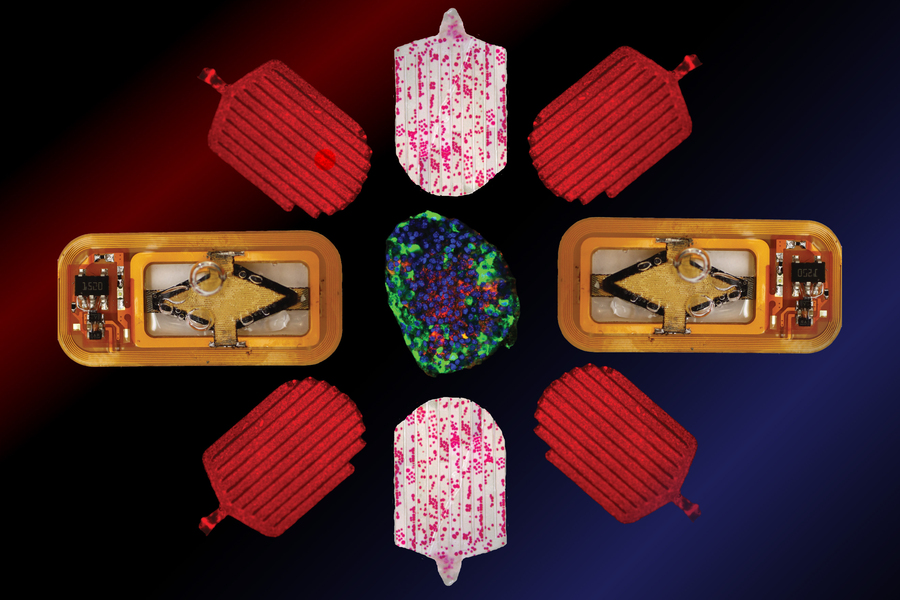
MIT researchers are developing an implantable device that contains insulin-producing cells.Credit: Courtesy of the researchers
<関連情報>
- https://news.mit.edu/2026/implantable-islet-cells-could-control-diabetes-without-insulin-injections-0326
- https://www.cell.com/device/abstract/S2666-9986(26)00036-0
ワイヤレスでバッテリー不要の酸素供給装置により、低侵襲部位での免疫抑制剤不要の膵島移植を延長することが可能になる Wireless battery-free oxygenation devices enable extended immunosuppression-free islet transplantation in minimally invasive sites
Siddharth R. Krishnan ∙ Matthew A. Bochenek ∙ Jingwen Pan ∙ … ∙ Jose Oberholzer ∙ Robert Langer ∙ Daniel G. Anderson
Device Published:March 26, 2026
DOI:https://doi.org/10.1016/j.device.2026.101084
The bigger picture
Successful pancreatic islet transplantation could offer a functional cure for type 1 diabetes. Currently, islet transplants require lifelong immunosuppression to prevent graft rejection. Encapsulation devices could address this challenge by excluding components of the host immune system, but oxygen limitations frustrate long-term cell survival in these devices. Here, we demonstrate the utility of a wireless, battery-free device and associated power transfer systems capable of providing both immunoprotection and oxygenation in addressing this challenge. These systems demonstrate enhanced (>90-day) robustness in vivo and are compatible with autoclave sterilization. Here, we show successful islet transplantation over 4 distinct transplantation models, all in subcutaneous sites with these devices. These models include allogeneic and xenogeneic islets and human stem-cell-derived islets, all in immunocompetent, diabetic rodents. Additionally, an initial proof of concept in a healthy nonhuman primate suggests potential for clinical translation. The choice of subcutaneous site suggests a pathway to minimally invasive, retrievable implants.
Highlights
- Implantable devices with in vivo robustness >90 days and autoclave compatibility
- 3-month diabetic reversal in rodents with allogeneic and xenogeneic islets
- 1-month allogeneic islet survival in subcutaneous site in nonhuman primate
- Wearable power transfer systems to support battery-free subcutaneous implants
Summary
Here, we develop a next-generation wireless, battery-free oxygen-generating O2-macrodevice and wearable power transfer platform that can enable long-term immunoprotection and subcutaneous function of therapeutic cells. We demonstrate that this device supports xenogeneic islet transplantation in C57BL/6J mice, evidenced by 90-day diabetes reversal and glucose responsiveness in vivo. We also show partial glycemic control via high-density (>8,000 islets/cm2) human stem-cell-derived islets (SC-islets) without immunosuppression in subcutaneous sites for 90 days. Additionally, we confirmed that the device supports allogenic islet cell survival and 90-day diabetic reversal in rats. Finally, we demonstrate 1-month islet survival in a nonhuman primate without the need for immunosuppression in the subcutaneous space. Collectively, these results indicate that the device supports cell survival and function across multiple transplant models in three species without the need for any immunosuppression or external user intervention. These results represent an important set of advances toward immunosuppression-free, minimally invasive islet transplantation.

