2025-06-24 ワシントン大学セントルイス校
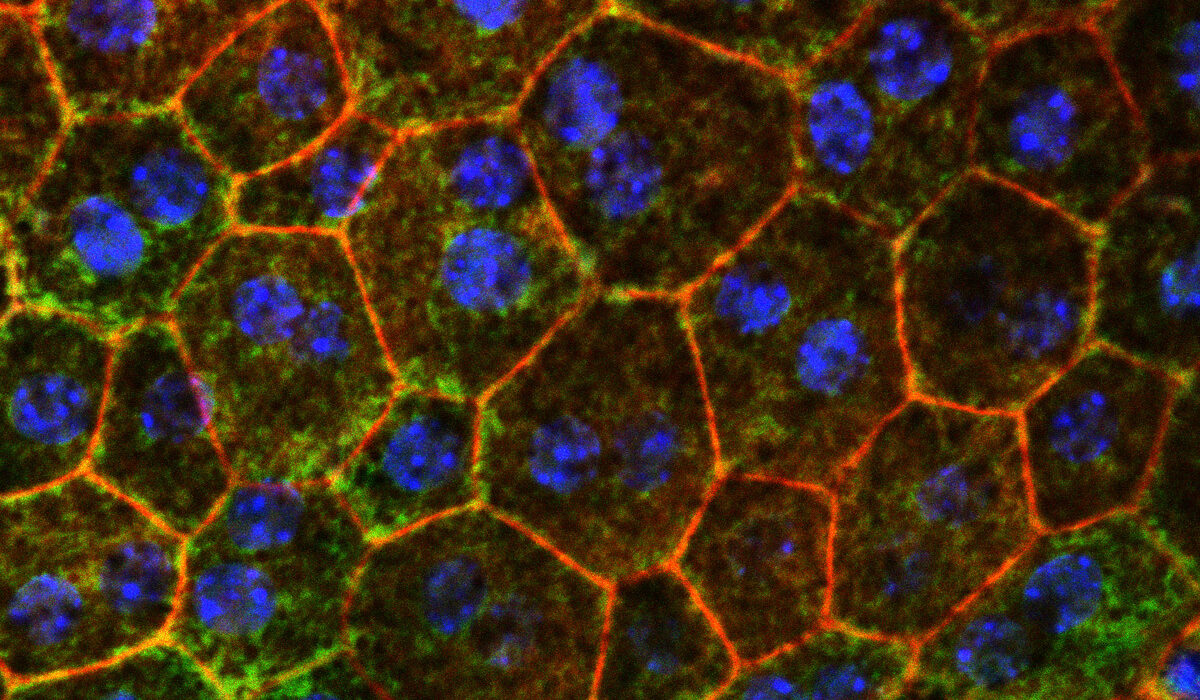
Fixing problems with cholesterol metabolism might help slow or prevent a common cause of age-related vision loss, a new WashU Medicine study in mice has shown. Pictured are color-stained retinal epithelial cells from a mouse eye, the first cells to die as age-related macular degeneration progresses. (Photo courtesy of Tim Lee/WashU Medicine)
<関連情報>
- https://source.washu.edu/2025/06/strategy-to-prevent-age-related-macular-degeneration-identified/
- https://medicine.washu.edu/news/strategy-to-prevent-age-related-macular-degeneration-identified/
- https://www.nature.com/articles/s41467-025-60830-1
アポリポタンパク質Mは、スフィンゴシン-1-リン酸シグナル伝達とリソソーム脂質異化を介して加齢黄斑変性の表現型を減弱させる Apolipoprotein M attenuates age-related macular degeneration phenotypes via sphingosine-1-phosphate signaling and lysosomal lipid catabolism
Tae Jun Lee,Andrea Santeford,Kristen M. Pitts,Carla Valenzuela Ripoll,Ryo Terao,Zhen Guo,Mualla Ozcan,Dagmar Kratky,Christina Christoffersen,Ali Javaheri & Rajendra S. Apte
Nature Communications Published:24 June 2025
DOI:https://doi.org/10.1038/s41467-025-60830-1
Abstract
Age-related macular degeneration (AMD) is a leading cause of blindness in people over 50. AMD and cardiovascular disease share risk factors including age, impaired lipid metabolism, and extracellular lipid deposition. Because of its importance in age-related diseases, we hypothesize that apolipoprotein M (ApoM), a lipocalin that binds sphingosine-1-phosphate (S1P), might restore lipid homeostasis and retinal function in AMD. In support, we find that human patients with AMD demonstrate significantly reduced ApoM compared to controls. In mice with impaired retinal cholesterol efflux, ApoM improves retinal pigment epithelium (RPE) function and lipotoxicity in an S1P- and S1P receptor 3-dependent manner. Ultrastructural evidence of enhanced melanosome-lipid droplet interactions led us to hypothesize and demonstrate that ApoM-S1P signaling drives RPE-specific lysosomal lipid catabolism. RPE-specific knockout of lysosomal acid lipase recapitulates features of AMD. Our study defines a novel role for ApoM/S1P signaling in AMD driven by RPE lipotoxicity, mediated by cell-autonomous lysosomal lipid catabolism.