2025-07-02 東京科学大学
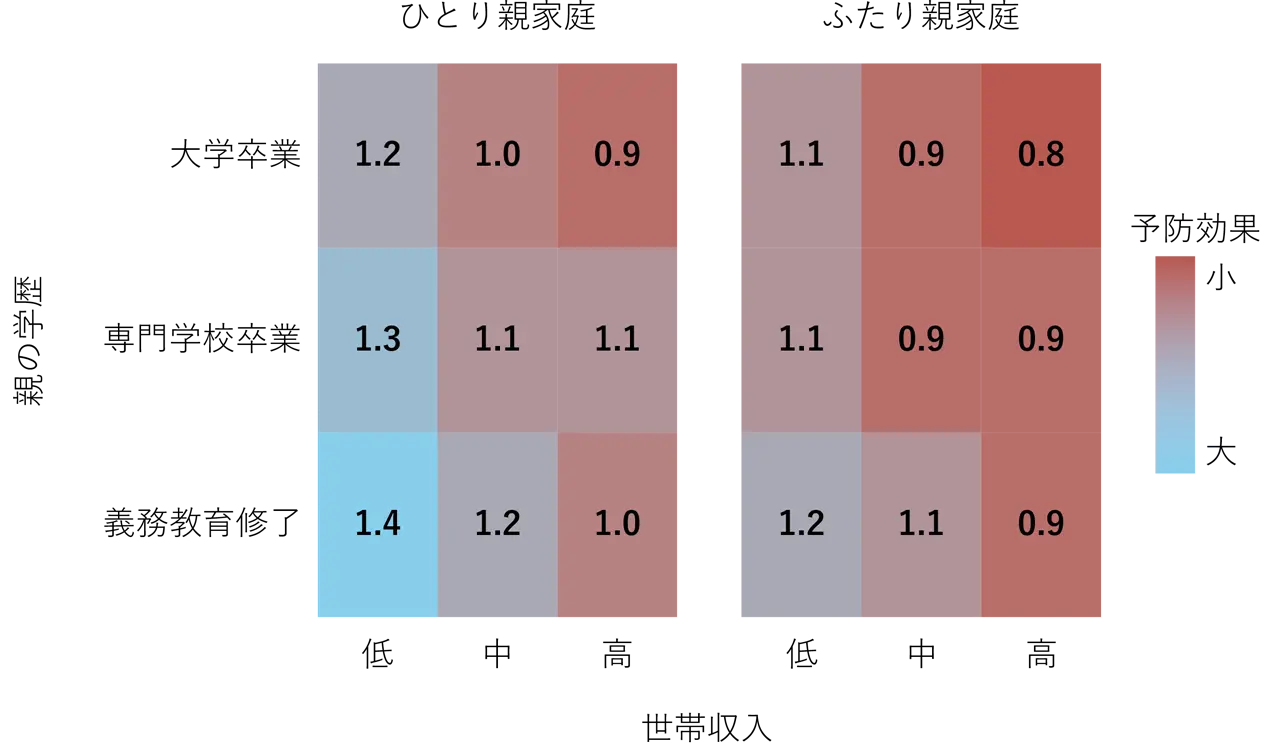 図1. 社会経済背景ごとにみた水道水フロリデーションのう蝕予防効果。個人・家庭・地域の46項目の情報を取り入れた分析結果を集計。数値は予防されるう蝕の平均数(歯面数)を示し、ひとり親家庭で収入が低い世帯など、社会経済的に不利な背景を持つ子どもで予防効果が大きいことが分かる。
<関連情報>
- https://www.isct.ac.jp/ja/news/6bkepixmkc9s
- https://www.isct.ac.jp/plugins/cms/component_download_file.php?type=2&pageId=&contentsId=1&contentsDataId=1548&prevId=&key=eaea82a2270c1aa7397d98dbfa51f6fb.pdf
- https://academic.oup.com/ije/article-abstract/54/4/dyaf080/8178774
口腔の健康格差を縮小するための人口戦略としてのウォーターフロリデーション:機械学習を用いた高次元効果不均一性分析 Water fluoridation as a population strategy for reducing oral health inequalities: high-dimensional effect heterogeneity analysis using machine learning
Yusuke Matsuyama , Diep H Ha , Sakura Kiuchi , Andrew J Spencer , Jun Aida , Loc G Do
International Journal of Epidemiology Published:01 July 2025
DOI:https://doi.org/10.1093/ije/dyaf080
Abstract
Background
Dental caries is the most prevalent disease worldwide, associated with substantial health inequalities. Water fluoridation is a population strategy shown to effectively prevent dental caries; however, its impact on health inequalities remains inconclusive. We investigated the high-dimensional effect heterogeneity of water fluoridation in preventing dental caries among children in Australia.
Methods
Data from the National Child Oral Health Study—a national representative study conducted in 2012–14, linked to the information on lifetime exposure to fluoridated water—were analysed (n = 17 517 children aged 5–14 years). A doubly robust target minimum loss-based estimation was used to estimate the average treatment effect of lifetime exposure to fluoridated water (never exposed versus fully exposed) on the number of tooth surfaces with dental caries. The effect heterogeneity was evaluated by estimating the conditional average treatment effects (CATEs) using the causal forest algorithm, which integrated 47 child demographic, socioeconomic, and parental factors.
Results
In total, 58.1% were fully exposed to water fluoridation throughout their lifetime. Water fluoridation was associated with having –0.9 (95% confidence interval: –1.1, –0.8) fewer dental caries incidents. The estimated CATEs were mostly negative and the magnitude substantially varied (median CATE, –0.9; interquartile range, 0.7). Children from lower socioeconomic backgrounds exhibited greater benefits: i.e. the average CATEs ranged from –1.4 for children from a single parent with school-level education and low-income families to –0.8 for children from two parents with tertiary-level education and high-income families.
Conclusion
Water fluoridation was associated with lower dental caries and exhibited greater benefits for vulnerable subpopulations.