2025-07-03 東京大学
東京大学の研究グループは、皮膚からの抗原侵入が食物アレルギーを引き起こす仕組みを解明しました。マウスに卵白抗原を皮膚投与すると、プロスタグランジンD₂(PGD₂)が増加し、CRTH2受容体を介してIgE抗体が産生され、アレルギー症状が発現。CRTH2欠損マウスや阻害薬処置ではIgEの産生と症状が抑制されました。この経路を標的とした介入は、皮膚バリアが弱い乳児などへの予防法開発に貢献する可能性があります。
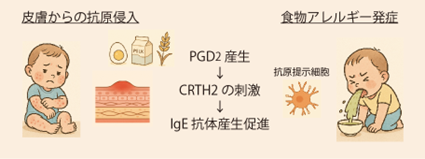
皮膚からの抗原侵入がIgE産生を促進し、食物アレルギーの発症につながるメカニズム
<関連情報>
- https://www.a.u-tokyo.ac.jp/topics/topics_20250703-1.html
- https://onlinelibrary.wiley.com/doi/10.1111/all.16635
皮膚由来PGD2はCRTH2シグナルを介して抗原特異的IgE産生を促進する Skin-Derived PGD2 Promotes Antigen-Specific IgE Production via CRTH2 Signaling
Misato Kida, Tatsuro Nakamura, Shingo Maeda, Nanae Nagata, Hirofumi Enomoto, Takahisa Murata
Allergy Published: 03 July 2025
DOI:https://doi.org/10.1111/all.16635
To the Editor,
Food allergy development is closely associated with epicutaneous sensitization, particularly via inflamed skin [1, 2]. Prostaglandin D2 (PGD2), a lipid mediator produced during inflammation, is a key contributor to allergic responses [3]. We investigated the role of PGD2 and its receptor, chemoattractant receptor-homologous molecule expressed on Th2 cells (CRTH2), in promoting antigen-specific IgE production through skin sensitization, using a murine food allergy model.