
2025-07-08 中国科学院(CAS)
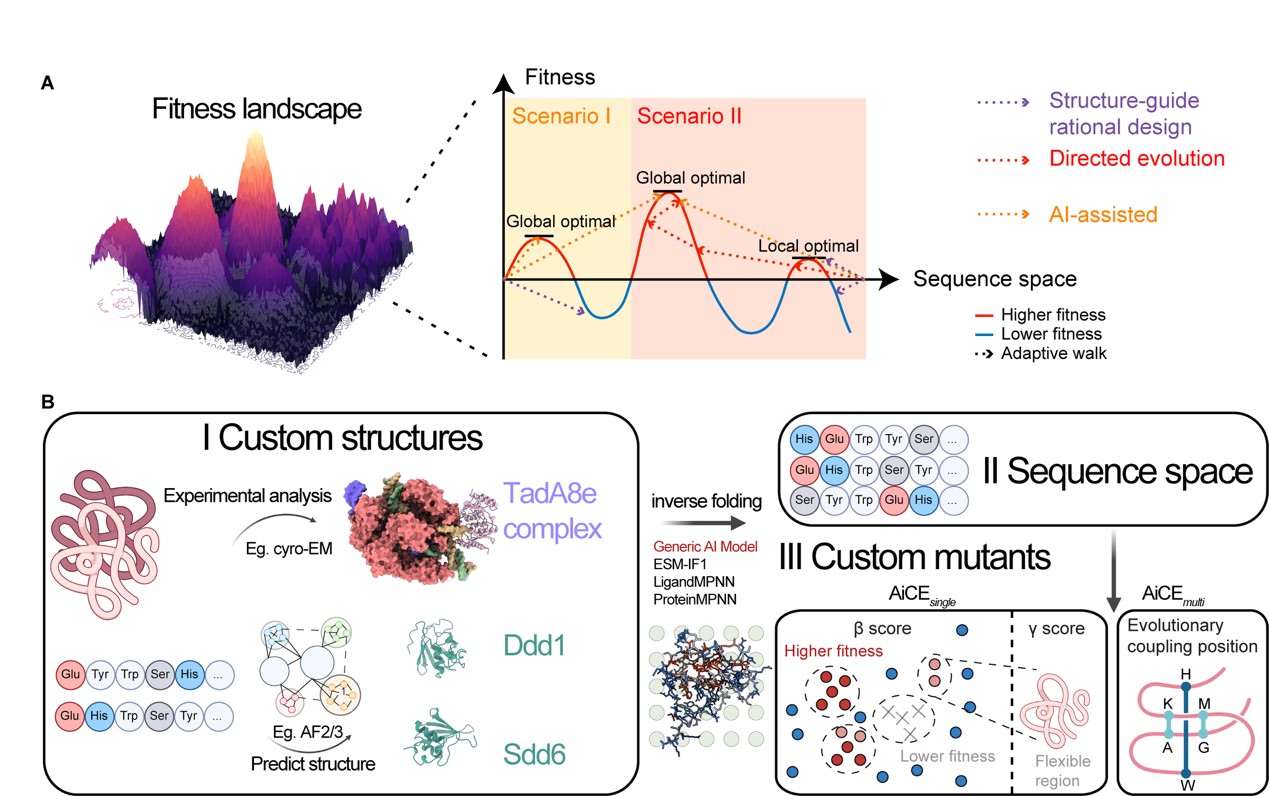
AiCE as an AI-informed approach for protein engineering (Image by IGDB)
<関連情報>
- https://english.cas.cn/head/202507/t20250707_1046910.shtml
- https://www.cell.com/cell/abstract/S0092-8674(25)00680-4
構造制約と進化制約を統合した逆フォールディングモデルによるタンパク質進化の進展 Advancing protein evolution with inverse folding models integrating structural and evolutionary constraints
Hongyuan Fei ∙ Yunjia Li ∙ Yijing Liu ∙ Jingjing Wei ∙ Aojie Chen ∙ Caixia Gao
Cell Published:July 7, 2025
DOI:https://doi.org/10.1016/j.cell.2025.06.014
Highlights
- Protein inverse folding models can effectively predict high-fitness mutations
- Structural and evolutionary constraints improve AiCE-driven protein evolution
- AiCE enables the development of precise and efficient base editors
- AiCE supports engineering of proteins with varying sizes, structures, and functions
Summary
Protein engineering enables artificial protein evolution through iterative sequence changes, but current methods often suffer from low success rates and limited cost effectiveness. Here, we present AI-informed constraints for protein engineering (AiCE), an approach that facilitates efficient protein evolution using generic protein inverse folding models, reducing dependence on human heuristics and task-specific models. By sampling sequences from inverse folding models and integrating structural and evolutionary constraints, AiCE identifies high-fitness single and multi-mutations. We applied AiCE to eight protein engineering tasks, including deaminases, a nuclear localization sequence, nucleases, and a reverse transcriptase, spanning proteins from tens to thousands of residues, with success rates of 11%–88%. We also developed base editors for precision medicine and agriculture, including enABE8e (5-bp window), enSdd6-CBE (1.3-fold improved fidelity), and enDdd1-DdCBE (up to 14.3-fold enhanced mitochondrial activity). These results demonstrate that AiCE is a versatile, user-friendly mutation-design method that outperforms conventional approaches in efficiency, scalability, and generalizability.
