2025-07-08 カリフォルニア大学バークレー校 (UCB)
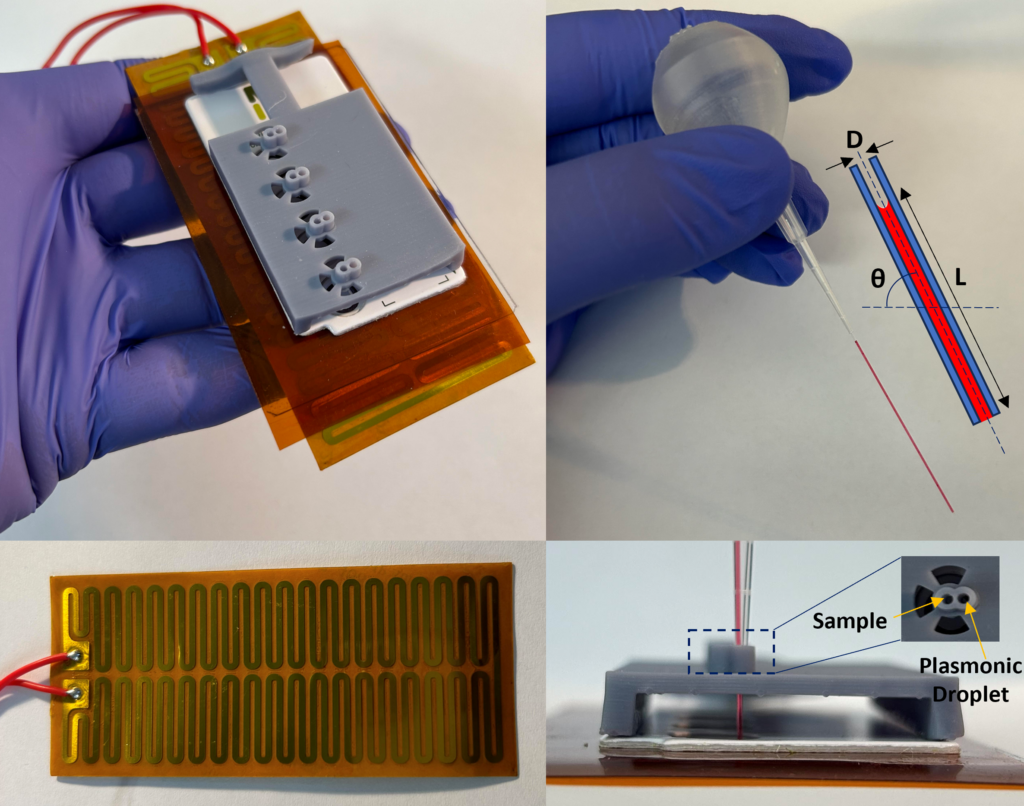
The researchers have create a prototype at-home test kit for the new diagnostic, which includes a 3D printed scaffold to help guide users on where to place the droplets (upper left), a syringe (upper right) and a small electric heater to speed evaporation (lower right).
Courtesy of Kamyar Behrouzi
<関連情報>
- https://news.berkeley.edu/2025/07/08/from-covid-to-cancer-new-at-home-test-spots-disease-with-startling-accuracy/
- https://www.nature.com/articles/s41467-025-59868-y
AI支援によるPOC診断のためのプラズモニックコーヒーリングバイオセンシング Plasmonic coffee-ring biosensing for AI-assisted point-of-care diagnostics
Kamyar Behrouzi,Zahra Khodabakhshi Fard,Chun-Ming Chen,Peisheng He,Megan Teng & Liwei Lin
Nature Communications Published:17 May 2025
DOI:https://doi.org/10.1038/s41467-025-59868-y
Abstract
A major challenge in addressing global health issues is developing simple, affordable biosensors with high sensitivity and specificity. Significant progress has been made in at-home medical detection kits, especially during the COVID-19 pandemic. Here, we demonstrated a coffee-ring biosensor with ultrahigh sensitivity, utilizing the evaporation of two sessile droplets and the formation of coffee-rings with asymmetric nanoplasmonic patterns to detect disease-relevant proteins as low as 3 pg/ml, under 12 min. Experimentally, a protein-laden droplet dries on a nanofibrous membrane, pre-concentrating biomarkers at the coffee ring. A second plasmonic droplet with functionalized gold nanoshells is then deposited at an overlapping spot and dried, forming a visible asymmetric plasmonic pattern due to distinct aggregation mechanisms. To enhance detection sensitivity, a deep neural model integrating generative and convolutional networks was used to enable quantitative biomarker diagnosis from smartphone photos. We tested four different proteins, Procalcitonin (PCT) for sepsis, SARS-CoV-2 Nucleocapsid (N) protein for COVID-19, Carcinoembryonic antigen (CEA) and Prostate-specific antigen (PSA) for cancer diagnosis, showing a working concentration range over five orders of magnitude. Sensitivities surpass equivalent lateral flow immunoassays by over two orders of magnitude using human saliva samples. The detection principle, along with the device, and materials can be further advanced for early disease diagnostics.