
2025-07-10 ワシントン大学セントルイス校
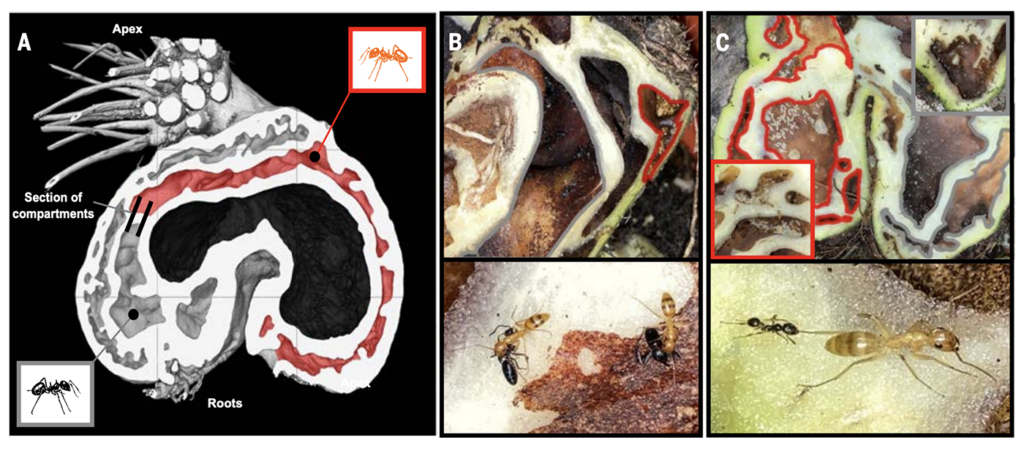
In this figure from the Science paper, photo panels show how experimental removal of compartmentalization leads to lethal conflict between ant colonies that were previously living in separate compartments. From left: (A) Schematic representation of the compartmentalization removal experiments. (B) Deadly conflicts between C. polynesicus (orange) and C. sadinus (black) ants. (C) Deadly conflicts between C. polynesicus (orange) and P. wilsonii (gray) ants. (Image: G. Chomicki and S. Renner, courtesy of Science)
<関連情報>
- https://source.washu.edu/2025/07/condo-style-living-helps-keep-the-peace-inside-these-ant-plants/
- https://www.science.org/doi/10.1126/science.adu8429
コンパートメント化は植物と昆虫の共生における葛藤を軽減する Compartmentalization reduces conflict in multipartner plant-insect symbioses
Guillaume Chomicki, Dirk Metzler, Alivereti Naikatini, and Susanne S. Renner
Science Published:10 Jul 2025
DOI:https://doi.org/10.1126/science.adu8429
Editor’s summary
Mutualistic relationships between ants and plants have evolved repeatedly. In these relationships, the ants often supply the plants with nutrients, while the plants provide structures suitable for ant nests, generally referred to as “domatia.” In some pairs, these relationships are exclusive, but in many others, a single plant species may have relationships with more than one ant species. However, such flexibility, although beneficial to the plant, poses a challenge because ants are often territorial and aggressive. Chomicki et al. studied such a promiscuous species of tropical vine and found that conflict among ant species was minimized or completely eradicated simply by physical separation within a single domatium. —Sacha Vignieri
Abstract
Many symbioses involve one host species having several mutualist partners, yet theory predicts that unrelated symbionts lead to destabilizing conflict through competition for host resources. We combined isotope labeling, computed-tomography three-dimensional models, behavioral field experiments, and mathematical models to show that Squamellaria plant hosts reduce conflict among their multiple ant symbiont species by offering nesting sites (domatia) divided into compartments with separate entrances. As long as compartmentalization is maintained, different symbiont species can peacefully coexist, but experimental removal of compartment walls leads to deadly conflicts. Modeling suggests that compartmentalization optimizes nutritional benefits by increasing the time during which domatia harbor large ant colonies. These results reveal a conflict-reduction mechanism that allows hosts to take advantage of unrelated symbionts, which may be widespread in multipartner mutualisms.

