2025-07-28 ジョージア工科大学
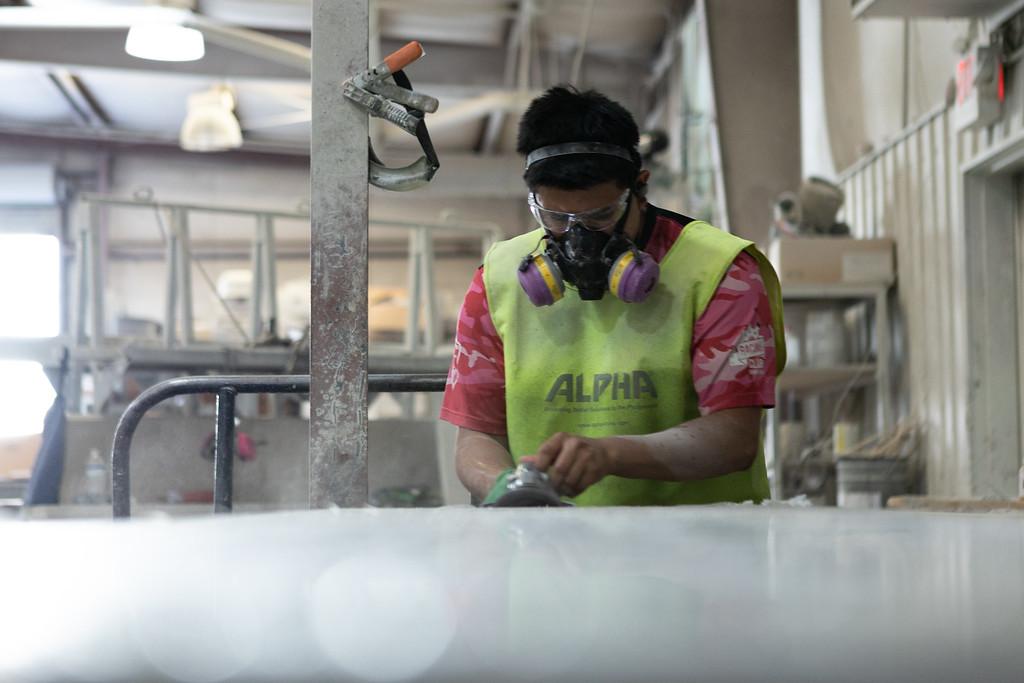
Javier Padilla, a sander with a metro Atlanta stone fabrication company, works on smoothing out a slab. (Photo: Mixed Bag Media)
<関連情報>
- https://news.gatech.edu/news/2025/07/28/scientists-pinpoint-hazards-engineered-stone-fabrication-shop-workers
- https://academic.oup.com/annweh/article/69/5/473/8116008
2017年から2023年までのジョージア州の人工石カウンタートップ製造工場の作業員における吸入可能粉塵と吸入可能結晶性シリカへの曝露 Respirable dust and respirable crystalline silica exposures among workers at stone countertop fabrication shops in Georgia from 2017 through 2023
Jhy-Charm Soo , Jenny Houlroyd , Hilarie Warren , Brandon J Philpot , Sean Castillo
Annals of Work Exposures and Health Published:18 April 2025
DOI:https://doi.org/10.1093/annweh/wxaf014
Abstract
Objectives
This longitudinal study examines the severity of worker exposure to respirable crystalline silica (RCS) and respirable dust and demonstrates the need for increased education and implementation of both appropriate engineering controls and respiratory protection (RP) programs for stone fabricator shops, given the growing global number of accelerated silicosis cases associated with the fabrication of engineered stone (ES) countertops.
Methods
Personal air sampling results and detailed job description notes obtained from 17 industrial hygiene air sampling visits conducted at 11 stone fabrication facilities between 2017 and 2023 in Georgia were used to align similar exposure groups (SEGs) for tasks for workers performing stone fabrication. Bayesian decision analysis was used to determine appropriate RP selection recommendations for the 4 proposed SEGs: SEG1—Support, SEG2—Automated Tool Operator, SEG 3—Small Tool Operator, and SEG 4—Fabrication/Lamination.
Results
The analysis concluded that all employees in stone fabrication shops that process ES should wear a respirator with a minimum assigned protection factor (APF) of 10, regardless of the engineering controls in place. For SEG 4, it is recommended that workers use respirators with an APF between 50 and 1,000. Among the 75 full-shift personal air samples for RCS dust, 41 samples (53%) exceeded the permissible exposure limit of 50 µg/m³.
Conclusions
This is the first study to present the 4 SEG categories with sampling data to support the importance of including all employees (even support workers) in RP programs, exposure monitoring, and medical surveillance.
Recommendation and implications
Employers, occupational health professionals, and inspectors may use these SEG categories and corresponding RP recommendations to determine if employees have received appropriate RP for workers at stone countertop fabrication shops.