2025-07-08 森林総合研究所,山階鳥類研究所
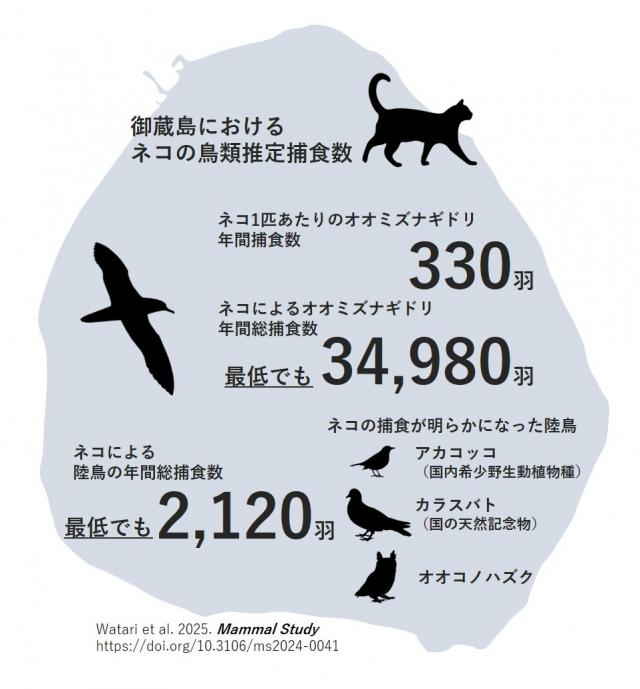
図1 本研究の主要結果の概要
<関連情報>
- https://www.ffpri.go.jp/press/2025/20250708/index.html
- https://www.ffpri.go.jp/press/2025/20250708/documents/20250708press.pdf
- https://bioone.org/journals/mammal-study/volume-50/issue-3/ms2024-0041/Unexpectedly-Early-and-Drastic-Dietary-Shift-of-Feral-Cats-to/10.3106/ms2024-0041.full
想定外に早くかつ急激な野生化ネコの海鳥への食性シフト:御蔵島におけるオオミズナギドリの繁殖シーズン移行期に捕獲されたネコの糞分析からのエビデンス Unexpectedly Early and Drastic Dietary Shift of Feral Cats to Seabirds: Evidence from Fecal Samples of Cats Captured during the Transition to the Breeding Season of the Streaked Shearwater on Mikura-Shima Island, Japan
Yuya Watari, Yuki Matsuyama, Mikuni Tokuyoshi, Tsugumi Nose, Hisayo Hayama, Kazuto Kawakami, Nariko Oka
Mammal Study Published:23 April 2025
DOI:https://doi.org/10.3106/ms2024-0041
Abstract
Invasive cat predation on island-breeding seabirds is a well-known example of impacts reducing insular biodiversity. The affected islands show drastic seasonal changes in primary prey for cats (i.e., seabirds), yet no studies have detected the timing of cats’ dietary shift to seabirds. Using camera trapping, opportunistic information gathering, and fecal analysis of cats captured during the transition season between the wintering and breeding seasons of the streaked shearwaters on Mikura-shima Island, we found that cats began unexpectedly preying on the shearwaters in the middle winter when the shearwaters ever reported to stay in the wintering waters, which was also earlier than the period shown by any other monitoring records in this study. We updated our estimate to 330 shearwaters annually killed by an average cat on the island. Though the cat population is yet unknown, at least 34 980 shearwaters will be killed annually, assuming the results of our recent cat trapping as the minimum population. In addition, three landbird species—Izu thrush, Japanese wood pigeon, and Japanese scops-owl—were detected in the cat feces. Mikura-shima Island lacks management by the relevant governments to solve the cat issue. Urgent action is needed from these administrations.