2025-09-19 国立長寿医療研究センター
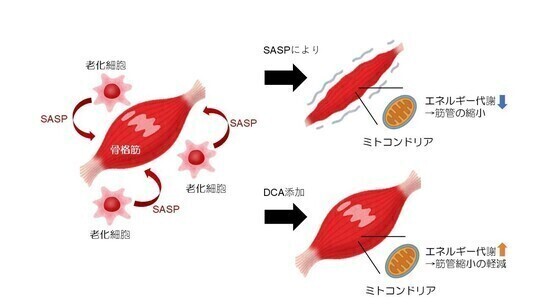
図. SASPが誘導する筋管萎縮とミトコンドリア機能障害
<関連情報>
- https://www.ncgg.go.jp/ri/report/20250918.html
- https://www.ncgg.go.jp/ri/report/documents/20250918.pdf
- https://journals.plos.org/plosone/article?id=10.1371/journal.pone.0326968
SASP依存性ヒト筋管培養により確立したサルコペニアの分子病態を研究するためのin vitroモデル An in vitro model to study molecular pathogenesis of sarcopenia established by a SASP-dependent human myotube culture
Kiyo-aki Ishii,Ryo Hashimoto,Chikako Umeda,Tohru Hosoyama,Ken Watanabe
PLOS One Published: July 7, 2025
DOI:https://doi.org/10.1371/journal.pone.0326968
Abstract
Sarcopenia is a condition that affects one’s activities of daily livingand is rapidly increasing with the ages of the global population. However, the basic molecular mechanisms for prevention and treatment are not fully understood. Although rodent model animals have many valuable aspects for studying sarcopenia, some aspects and mechanisms differ from humans, such as immune response, metabolism, stress response, and myofiber composition. This study established a human cell-based in vitro model to elucidate the molecular mechanism by which SASP from senescence-induced human mesenchymal stem cells led to the narrowing of human myotube diameter, suggesting that this model is useful for studying sarcopenia. Gene expression profiling was performed the molecular mechanisms and devel on the model by RNA sequencing to identify genes whose expression was affected by SASP. Among these, the exposure to SASP upregulated PDK4 expression, and a PDK4 inhibitor, DCA, could increase myotube diameter and reverse SASP-mediated narrowing of the diameter. Pathway analyses suggested that SASP affected energy metabolism by activating OXPHOS and promoting the expression of mitochondrial function-related genes and mitochondrial biosynthesis factors. These results provide insights that contribute to developing new treatments for sarcopenia.