2025-10-10 中国科学院(CAS)
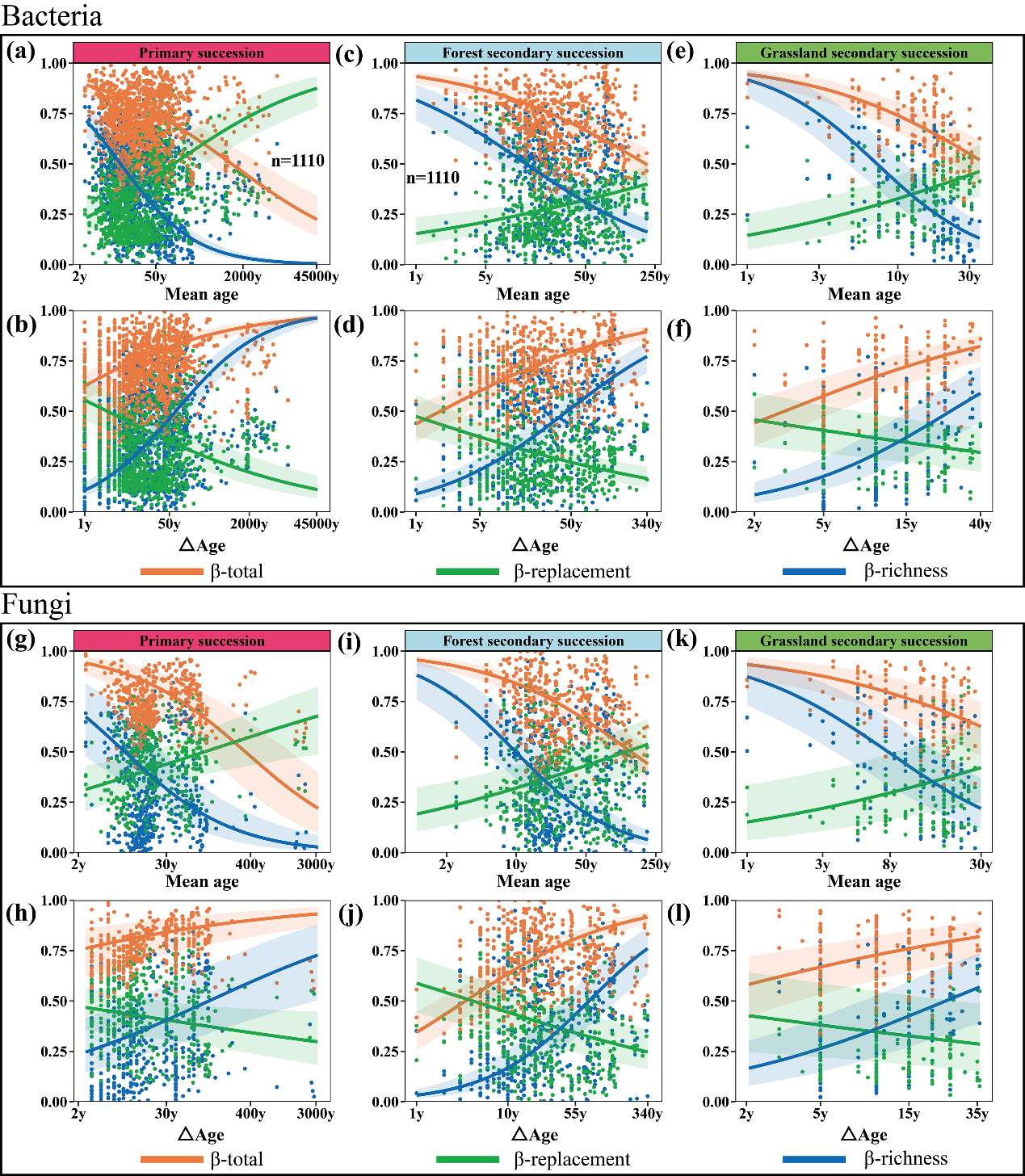
Change patterns of β-diversity and its components of bacterial and fungal communities over succession. (Image by WBG)
<関連情報>
- https://english.cas.cn/newsroom/research_news/life/202510/t20251010_1089031.shtml
- https://onlinelibrary.wiley.com/doi/10.1111/gcb.70475
土壌微生物遷移のパターンと環境要因 Patterns and Environmental Drivers of Soil Microbial Succession
Zhi Yu, Xiao-min Zeng, Xiaoli Cheng, Quanfa Zhang, Kerong Zhang
Global Change Biology Published: 30 August 2025
DOI:https://doi.org/10.1111/gcb.70475
ABSTRACT
Succession has been a central theme of ecology for over a century, yet the patterns and drivers of soil microbial succession remain less well understood. Here, we analyzed the raw sequencing data of 5184 soil samples involving microbial succession, including primary succession, forest and grassland secondary succession. We provide the first evidence that the β-diversity (β-total, compositional dissimilarity between communities) of soil bacterial and fungal communities both decreased significantly with successional age in the three successional types. This indicates that convergent succession (i.e., decrease in β-total with time) is prevalent and independent of successional types and initial conditions. Partitioning β-total into species addition and replacement revealed that species addition dominates in early succession and then declines with successional age, whereas species replacement shows an increasing pattern over succession and ultimately dominates the late-successional communities. The convergent succession is mainly attributed to the directional species replacement and is driven by the changes in soil properties. In primary succession, β-total in bacterial communities is negatively correlated with soil total nitrogen (TN), soil organic carbon (SOC), NO3–-N, and NH4+-N, and β-total in fungal communities is negatively related to soil TN, NH4+-N, and NO3–-N. In forest secondary succession, β-total in bacterial communities is negatively correlated with TN and SOC, and β-total in fungal communities is negatively related to TN, SOC, and NH4+-N. In grassland secondary succession, β-total in bacterial communities is positively associated with the changes in soil pH (ΔpH), and β-total in fungal communities is negatively related to TN and SOC. Except for grassland bacterial succession, soil microbial communities generally shift from r-strategy (copiotrophs) to K-strategy (oligotrophs) during succession. Together, our study fills the knowledge gap in soil microbial succession patterns and highlights the universality of community convergence as predicted by the classical macroecological model.