
2025-10-27 ノースカロライナ州立大学(NCState)
<関連情報>
- https://news.ncsu.edu/2025/10/high-levels-of-short-chain-pfas-found-in-wilmington-residents-blood/
- https://pubs.acs.org/doi/10.1021/acs.est.5c08146
ノースカロライナ州ウィルミントンの歴史的血清サンプル:超短鎖パーフルオロアルキル化合物およびポリフルオロアルキル化合物の重要性 Historical Blood Serum Samples from Wilmington, North Carolina: The Importance of Ultrashort-Chain Per- and Polyfluoroalkyl Substances
Lan Cheng,Sarah Teagle,Jeffrey R. Enders,Rebecca A. Weed,Hazel B. Nichols,Detlef R.U. Knappe,and Jane A. Hoppin
Environmental Science & Technology Published: October 27, 2025
DOI:https://doi.org/10.1021/acs.est.5c08146
Abstract
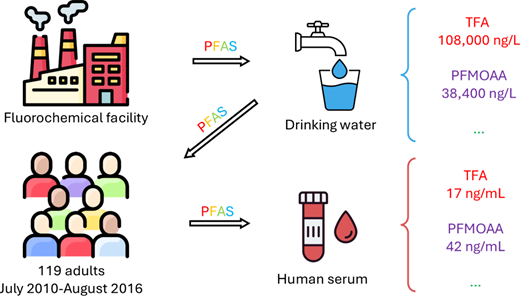
From 1980 to 2017, Wilmington, North Carolina (NC), residents unknowingly consumed high levels of PFAS through drinking water. Some of these PFAS are expected to have short biological half-lives, and current biological sampling will miss these exposures. To assess historical PFAS exposures, we (1) determined PFAS levels in serum samples of Wilmington, NC residents obtained during the years 2010–2016, (2) examined temporal trends of serum PFAS over this period, and (3) associated serum PFAS levels with PFAS concentrations in drinking water. We quantified 56 PFAS, including ultrashort-chain PFAS, in 119 adult human serum samples and 47 PFAS in water samples from 2017. Twenty PFAS were detected in >50% of serum samples; perfluoromethoxyacetic acid (PFMOAA) and trifluoroacetic acid (TFA) exhibited the highest median concentrations (PFMOAA: 42 ng/mL; TFA: 17 ng/mL). PFMOAA and TFA were also the dominant PFAS in Wilmington drinking water, accounting for 95% of quantifiable PFAS. The serum-to-water ratio was linearly correlated with “effective” PFAS chain length, indicating that PFAS with longer chain length and a sulfonic acid group are more bioaccumulative. While chain length is important for bioaccumulation, this study highlights that exposures to high concentrations of ultrashort-chain PFAS in drinking water contribute to their dominance in human serum.

