2025-10-31 東京科学大学
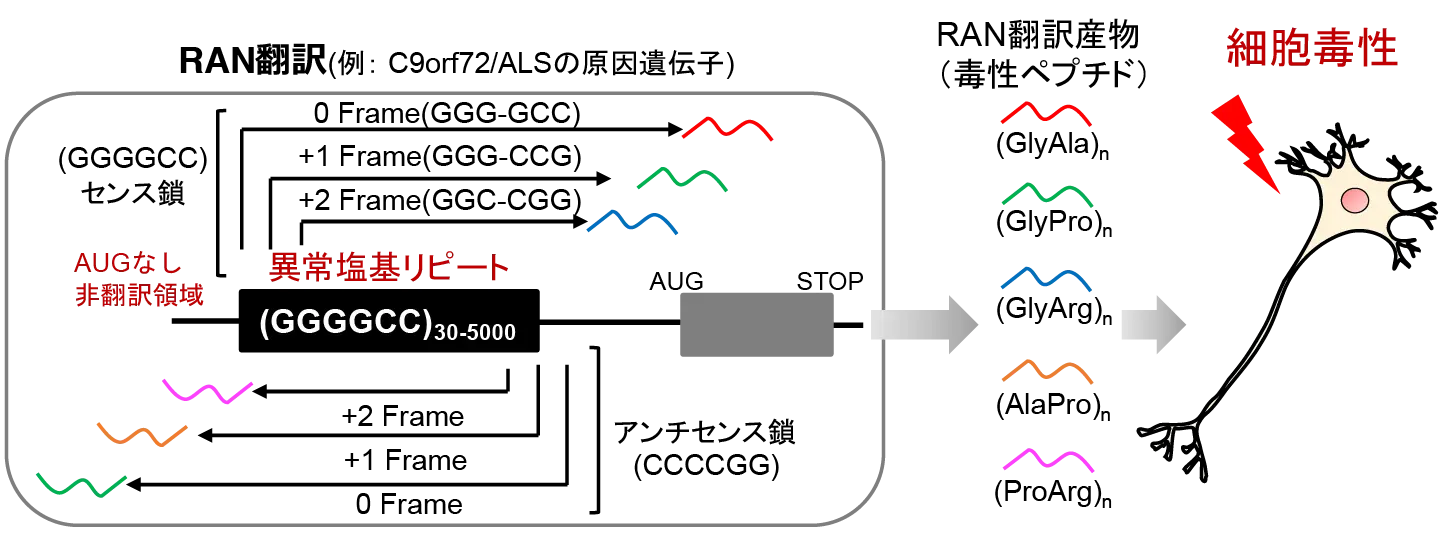
図1. RAN翻訳の概略図
タンパク質が合成されないと考えられていた遺伝子領域から、さまざまなタンパク質が作られ、それらが細胞毒性を示す。
<関連情報>
- https://www.isct.ac.jp/ja/news/ss1sk3v0zfh6
- https://academic.oup.com/nar/article/53/18/gkaf994/8277922
標準的な翻訳因子eIF1AとeIF5Bは、反復配列に関連する非AUG翻訳の開始段階を調節する Canonical translation factors eIF1A and eIF5B modulate the initiation step of repeat-associated non-AUG translation
Hayato Ito, Kodai Machida, Yuzo Fujino, Mayuka Hasumi, Soyoka Sakamoto, Yoshitaka Nagai, Hiroaki Imataka, Hideki Taguchi
Nucleic Acids Research Published:08 October 2025
DOI:https://doi.org/10.1093/nar/gkaf994
Abstract
Nucleotide repeat expansions, such as the GGGGCC repeats in C9orf72, associated with C9-ALS, are linked to neurodegenerative diseases. These repeat sequences undergo a noncanonical translation known as repeat-associated non-AUG (RAN) translation. Unlike canonical translation, RAN translation initiates from non-AUG codons and occurs in all reading frames. To identify potential regulators of RAN translation, we employed a bottom-up approach using a human factor-based reconstituted cell-free translation system to recapitulate RAN translation. This approach revealed that omission of either eIF1A or eIF5B enhanced the translation in all reading frames of C9orf72-mediated RAN translation (C9-RAN), suggesting that eIF1A and eIF5B act as repressors of RAN translation. eIF1A and eIF5B are known to contribute to the fidelity of translation initiation. In HEK293T cells, double knockdown of eIF1A and eIF5B further promoted C9-RAN compared to single knockdowns, indicating that these factors regulate C9-RAN through distinct initiation steps. Furthermore, under eIF1A knockdown conditions, the enhancement of RAN translation via the integrated stress response (ISR) was not observed in HEK293T cells, indicating that eIF1A is involved in the ISR-mediated non-AUG translation.