2025-11-11 ニューヨーク大学 (NYU)
<関連情報>
- https://www.nyu.edu/about/news-publications/news/2025/november/study-sheds-new-light-on-how-hormones-influence-decision-making-.html
- https://www.nature.com/articles/s41593-025-02104-z
エストロゲンは報酬予測誤差と強化学習を調節する Estrogen modulates reward prediction errors and reinforcement learning
Carla E. M. Golden,Audrey C. Martin,Daljit Kaur,Andrew Mah,Diana H. Levy,Takashi Yamaguchi,Amy W. Lasek,Dayu Lin,Chiye Aoki & Christine M. Constantinople
Nature Neuroscience Published:11 November 2025
DOI:https://doi.org/10.1038/s41593-025-02104-z
Abstract
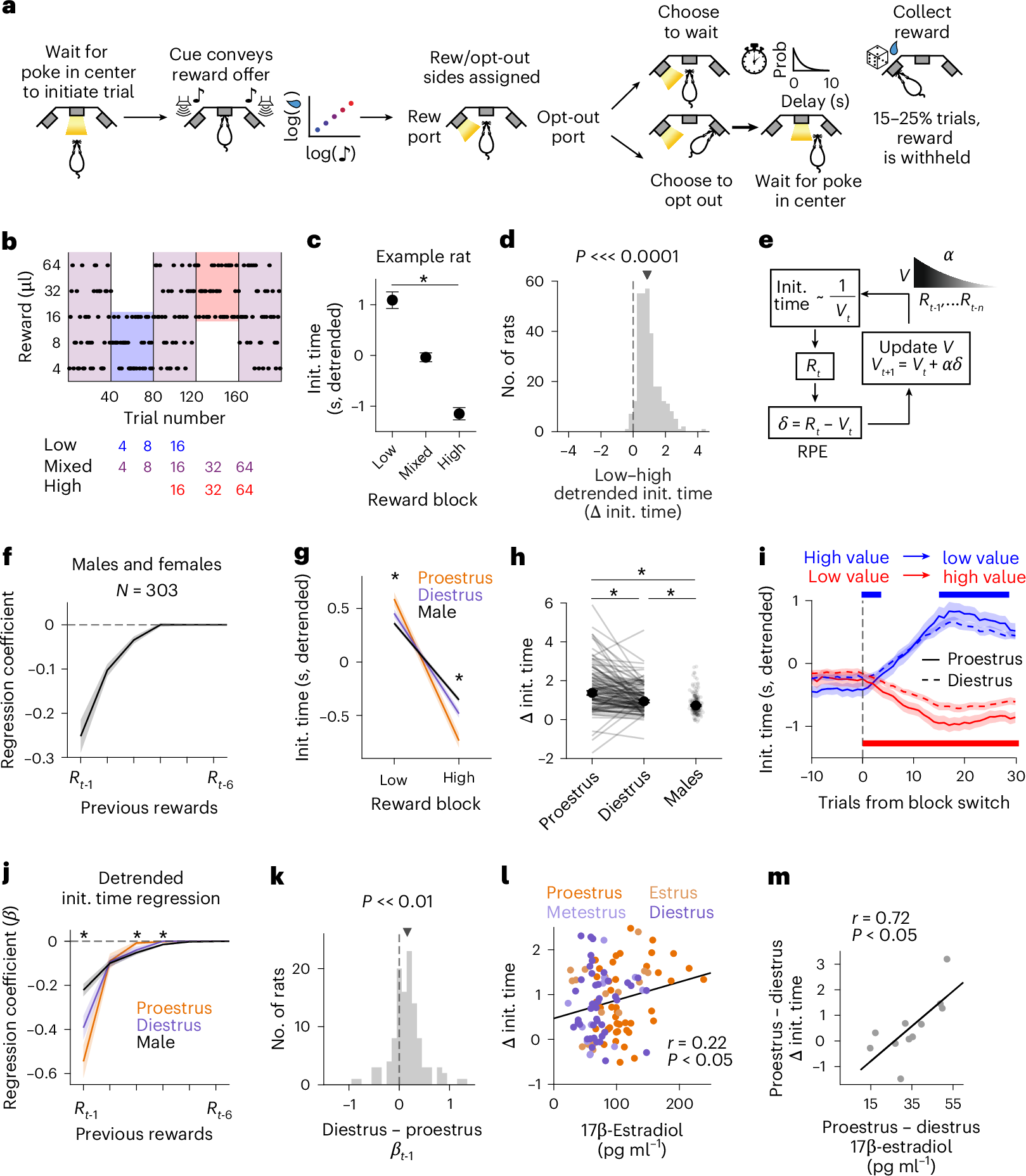
Gonadal hormones act throughout the brain and modulate psychiatric symptoms. Yet how hormones influence cognitive processes is unclear. Exogenous 17β-estradiol, the most potent estrogen, modulates dopamine in the nucleus accumbens core, which instantiates reward prediction errors (RPEs), the difference between received and expected reward. Here we show that following endogenous increases in 17β-estradiol, dopamine RPEs and behavioral sensitivity to previous rewards are enhanced, and nucleus accumbens core dopamine reuptake proteins are reduced. Rats adjusted how quickly they initiated trials in a task with varying reward states, balancing effort against expected rewards. Nucleus accumbens core dopamine reflected RPEs that influenced rats’ initiation times. Higher 17β-estradiol predicted greater sensitivity to reward states and larger RPEs. Proteomics revealed reduced dopamine transporter expression following 17β-estradiol increases. Finally, knockdown of midbrain estrogen receptors suppressed sensitivity to reward states. Therefore, endogenous 17β-estradiol predicts dopamine reuptake and RPE signaling, and causally dictates the impact of previous rewards on behavior.