
2025-11-13 中国科学院(CAS)
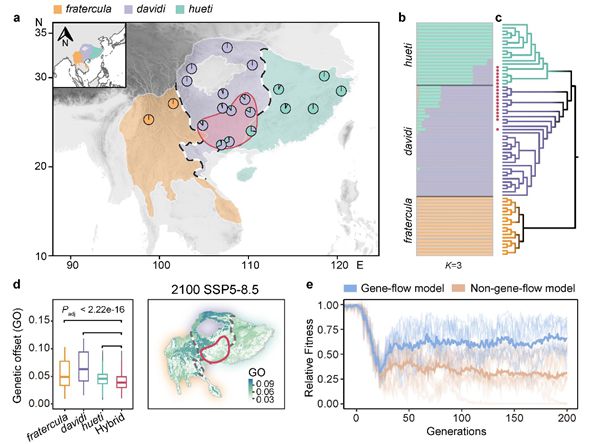
Interspecific introgression mitigates the climate change risk. (Image by QU Yanhua’s Lab)
<関連情報>
- https://english.cas.cn/newsroom/research_news/life/202511/t20251112_1099438.shtml
- https://www.nature.com/articles/s41558-025-02485-w
交雑により山岳鳥類の気候変動リスクが軽減される Hybridization mitigates climate change risk in mountainous birds
Shuai Zhang,Yilin Chen,Wenqing Zang,Xinlai Wu,Per G. P. Ericson,Fumin Lei & Yanhua Qu
Nature Climate Change Published:10 November 2025
DOI:https://doi.org/10.1038/s41558-025-02485-w
Abstract
Climate change is rapidly driving environmental shifts, posing an increasing threat to global biodiversity. Interspecific introgression—in which genetic material is transferred from one species to another following hybridization—may facilitate climate adaptation by introducing new genetic variation, which could mitigate species’ vulnerability to changing conditions. Here, using population and ecological genomic approaches and genetic offset modelling for future climates, we show that hybrid mountainous birds showed reduced vulnerability to climate change compared with non-hybrid counterparts. While geographic isolation and ecological heterogeneity promoted species divergence and distinct climatic niche requirements, gene flow persists at contact zones between these species. Maintaining current gene flow rates is projected to buffer against climate change risks over the next 40 generations. These findings demonstrate the role of interspecific introgression in enhancing climate resilience and future survival, and emphasize the conservation importance of preserving gene flow among species with narrow environmental tolerances.

