2025-11-15 復旦大学
<関連情報>
- https://www.fudan.edu.cn/en/2025/1115/c344a147321/page.htm
- https://www.nature.com/articles/s41586-025-09745-x
細胞質アセチルコエンザイムAは、ミトファジーを制御するシグナル伝達代謝物である Cytosolic acetyl-coenzyme A is a signalling metabolite to control mitophagy
Yifan Zhang,Xiao Shen,Yuan Shen,Chao Wang,Chengping Yu,Jiangxue Han,Siyi Cao,Lin Qian,Miaolian Ma,Shijing Huang,Wenyu Wen,Miao Yin & Qun-Ying Lei
Nature Published:12 November 2025
DOI:https://doi.org/10.1038/s41586-025-09745-x
Abstract
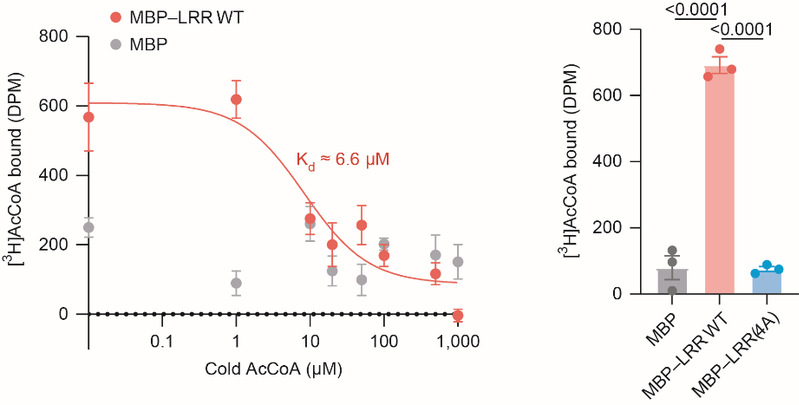
Acetyl-coenzyme A (AcCoA) sits at the nexus of nutrient metabolism and shuttles between the canonical and non-canonical tricarboxylic acid cycle1,2, which is dynamically regulated by nutritional status, such as fasting3. Here we find that mitophagy is triggered after a reduction in cytosolic AcCoA levels through short-term fasting and through inhibition of ATP-citrate lyase (encoded by ACLY), mitochondrial citrate/malate antiporter (encoded by SLC25A1) or acyl-CoA synthetase short chain family member 2 (encoded by ACSS2), and the mitophagy can be counteracted by acetate supplementation. Notably, NOD-like receptor (NLR) family member X1 (NLRX1) mediates this effect. Disrupting NLRX1 abolishes cytosolic AcCoA reduction-induced mitophagy both in vitro and in vivo. Mechanically, the mitochondria outer-membrane-localized NLRX1 directly binds to cytosolic AcCoA within a conserved pocket on its leucine-rich repeat (LRR) domain. Moreover, AcCoA binds to the LRR domain and enhances its interaction with the nucleotide-binding and oligomerization (NACHT) domain, which helps to maintain NLRX1 in an autoinhibited state and prevents the association between NLRX1 and light chain 3 (LC3). Furthermore, we find that the AcCoA–NLRX1 axis underlies the KRAS-inhibitor-induced mitophagy response and promotes drug resistance, providing a metabolic mechanism of KRAS inhibitor resistance. Thus, cytosolic AcCoA is a signalling metabolite that connects metabolism to mitophagy through its receptor NLRX1.