
2025-11-18 順天堂大学
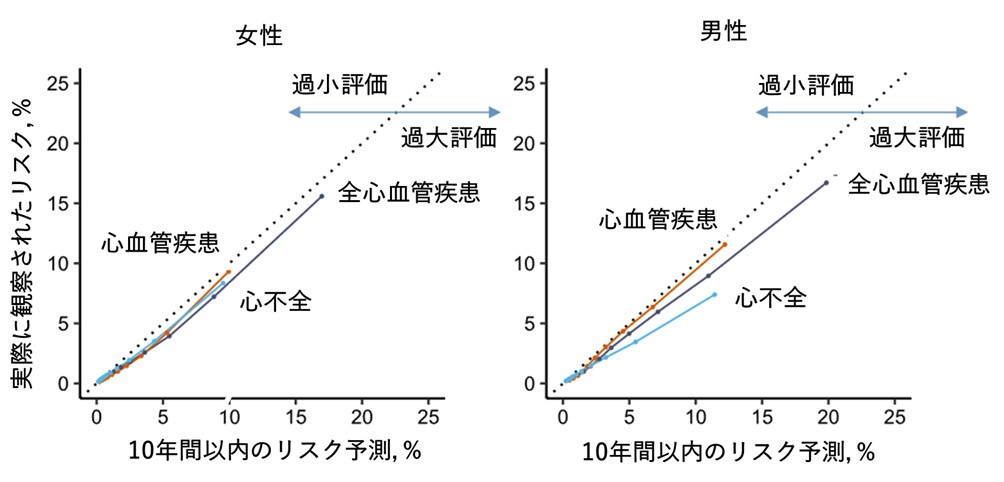 図.アジア人におけるPREVENT予測式の精度評価
各アウトカムにおけるキャリブレーション(傾きおよび予測リスクのデシルごとの観測値と予測値のプロット)。キャリブレーションプロットでは、観測リスクの95%信頼区間に対応する誤差線が短すぎて可視化されなかった。これらのモデルには、HDLコレステロールとnon-HDLコレステロール(全心血管疾患および心血管疾患の場合)、BMI(心不全の場合)、収縮期血圧、糖尿病、現在の喫煙状況、推算糸球体濾過量(eGFR)、降圧薬またはスタチンの使用、年齢が予測因子として含まれている。
全心血管疾患=心筋梗塞、致死性冠動脈疾患、致死性/非致死性脳卒中、および心不全、心血管疾患=心筋梗塞、致死性冠動脈疾患、致死性/非致死性脳卒中
<関連情報>
770万人の韓国成人を対象とした、心血管疾患リスク予測式PREVENTの有効性評価
Evaluation of the PREVENT Equations in a Nationwide Cohort of 7.7 Million Korean Adults
Hokyou Lee, Kosuke Inoue, Dasom Son, Yuichiro Mori, Eugene Yang, Yuichiro Yano, Hyeon Chang Kim, Dhruv S. Kazi, Donald M. Lloyd-Jones, and Sadiya S. Khan
Journal of American College of Cardiology Published:1 December 2025
DOI:https://doi.org/10.1016/j.jacc.2025.09.1591
The Predicting Risk of Cardiovascular Disease Events (PREVENT) equations were developed to accurately estimate risk for total
cardiovascular disease (CVD), atherosclerotic cardiovascular disease (ASCVD), and heart failure (HF).1 While developed for U.S. adults, understanding their performance in non-U.S. samples can inform global generalizability.2 This is particularly relevant for multinational cardiovascular outcome trials that consider risk for inclusion or subgroup analyses. Validating PREVENT in the Korean population is of interest given the distinct CVD burden and previous studies of U.S.-based models overestimating risk in this group (ie, pooled cohort equations [PCEs]).2,3 The Korean National Health Insurance Service (KNHIS) cohort is a large nationwide dataset with detailed assessment of CVD risk factors and >10 years of follow-up, ideal for interrogating this question.4 Therefore, we evaluated PREVENT and compared it with PCEs using the KNHIS cohort.

