
2025-12-02 東京科学大学
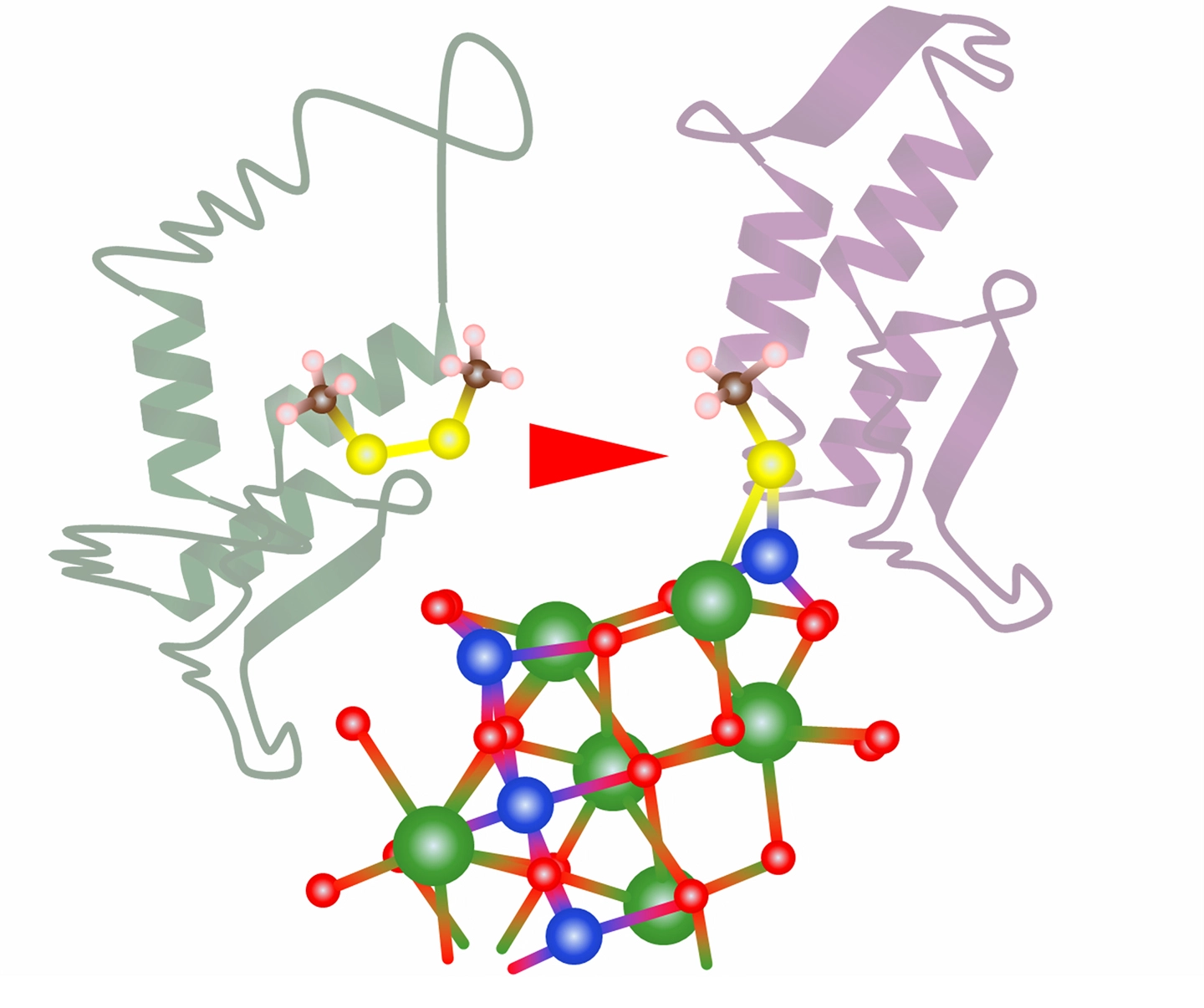 図1. 第一原理計算により評価を行ったジスルフィド結合の切断のイメージ
<関連情報>
- https://www.isct.ac.jp/ja/news/enxk8jwwd8it
- https://www.isct.ac.jp/plugins/cms/component_download_file.php?type=2&pageId=&contentsId=1&contentsDataId=2694&prevId=&key=acabeab51ec2cbe7a2c9366617f8a790.pdf
- https://pubs.acs.org/doi/10.1021/acsami.5c17978
第一原理に基づくメカニズムの洞察によるLa 2 CuO 4およびY 2 Cu 2 O 5の調製と抗ウイルス活性 Preparation and Antiviral Activity of La2CuO4 and Y2Cu2O5 with Mechanistic Insights from First-Principles
Ryuju Kiribayashi,Kayano Sunada,Toshihiro Isobe,Keiichi Kobayashi,Takeshi Nagai,Hitoshi Ishiguro,Yasuhide Mochizuki,and Akira Nakajima
ACS Applied Materials & Interfaces Published: October 21, 2025
DOI:https://doi.org/10.1021/acsami.5c17978
Abstract
Copper oxide is a representative inorganic antiviral material. However, the highly active Cu2O phase transforms gradually into CuO, which results in reduced antiviral activity. For this study, we aimed at developing a material with high antiviral activity based on CuO. To this end, La2CuO4 and Y2Cu2O5 were synthesized respectively by combining CuO with La2O3 and Y2O3. Their antiviral properties were investigated. For comparison, Al2CuO4 and the simple oxides of each constituent element were also prepared and evaluated. The ternary oxides synthesized using citric acid combustion method and the solid-state reaction method were confirmed to be single-phase. Surface analysis revealed the presence of Cu+ on La2CuO4 and Y2Cu2O5. The amount of ion release from these materials was found to be low. Antiviral activity tests were conducted against the nonenveloped bacteriophage Qβ and the enveloped bacteriophage Φ6, following ISO-standard evaluation methods. La2CuO4 and Y2Cu2O5 exhibited stronger antiviral activity against Qβ than either CuO, La2O3, or Y2O3. Detailed analyses suggested that the enhanced activity was attributable to strengthened electrostatic interactions and an improved ability to inactivate proteins. In contrast, La2O3 and Y2O3 showed relatively high antiviral activity against Φ6, primarily because of their strong affinity for phosphate groups. First-principles calculations indicate that (i) the surfaces of these ternary oxides containing Cu2+ are cation-rich and (ii) the surface formal charge of copper is predominantly monovalent. These findings suggest that the unique surface states because of their crystal structures play a crucially important role in the antiviral performance of La2CuO4 and Y2Cu2O5. The antiviral activity of La2CuO4 against Qβ exhibited high long-term stability, surpassing the reported performance of Cu2O. The present study is expected to provide promising new materials with improved antiviral activities compared to conventional CuO.
