2025-12-15 ワシントン州立大学(WSU)
<関連情報>
- https://news.wsu.edu/press-release/2025/12/15/modulating-key-interaction-prevents-virus-from-entering-cells/
- https://pubs.rsc.org/en/content/articlelanding/2025/nr/d5nr03235k
機械学習から予測されるウイルス融合タンパク質内の特定の相互作用の調節が膜融合を阻害する Modulation of specific interactions within a viral fusion protein predicted from machine learning blocks membrane fusion
Ryan E. Odstrcil,Albina O. Makio,McKenna A. Hull,Prashanta Dutta,Anthony V. Nicola and Jin Liu
Nanoscale Published:04 Nov 2025
DOI:https://doi.org/10.1039/D5NR03235K
Abstract
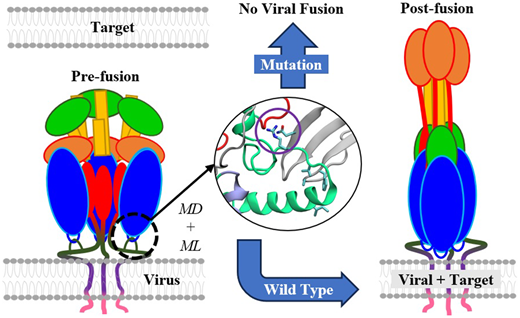
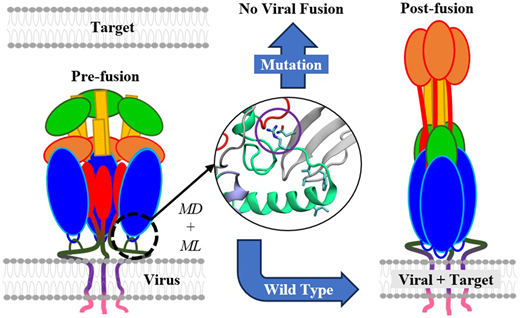
Enveloped viruses must enter host cells to initiate infections through a fusion process, during which the fusion proteins undergo significant and complex structural changes from pre-fusion to post-fusion conformations. Understanding of the fusion protein conformational stability, and rapid and accurate identification of the stabilizing interactions are critically important for inhibiting the infections. Here, we leverage molecular dynamics simulations, novel machine learning models and biological experiments to identify the crucial interactions dictating the structural stability of glycoprotein B (gB), a class III fusion protein. We focused on the interactions between the fusion loops and the membrane proximal region in gB. A new Q181–R747 polar interaction was identified from our machine learning model as critical in stabilizing the gB pre-fusion conformation. Molecular simulations revealed that mutation of Q181 with proline (Q181P) disrupted the fusion loop secondary structure and reduced gB pre-fusion stability. Experiments were designed to evaluate the impact of the Q181P on fusion. Strikingly, the mutation completely abrogated gB membrane fusion activity. The experiments confirmed the importance of Q181–R747 interaction on fusion, which is consistent with the model predictions. The results deepen our fundamental understanding of the molecular mechanisms of gB during viral fusion, which may lead to novel antiviral interventions. The modeling and experimental framework can be generalized to rapidly identify the critical intermolecular interactions in other important biological processes.