2025-12-15 京都大学
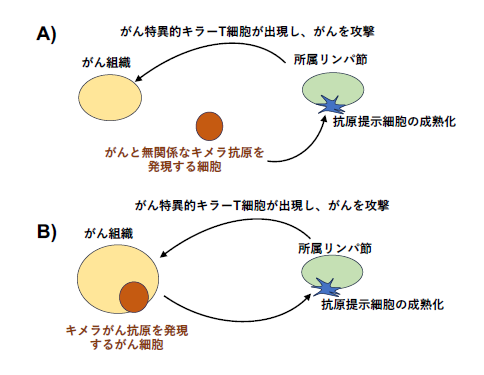
A) キメラペプチドを生体内の細胞に発現させると、がん抗原に無関係な配列でもがん特異的キラーT細胞が出現する。B) この様なキメラ型配列をがん抗原として発現するがん細胞が一部でも存在すると、がん特異的キラーT細胞が出現し抗腫瘍免疫が増強する。
<関連情報>
- https://www.kyoto-u.ac.jp/ja/research-news/2025-12-15-2
- https://www.kyoto-u.ac.jp/sites/default/files/2025-12/web_2512_Chamoto-377a8927a9fac442d1247417af353f53.pdf
- https://rupress.org/jem/article/223/2/e20250025/278553/Chimeric-MHC-class-I-and-II-restricted-non-self
キメラMHCクラスIおよびII拘束性非自己エピトープは抗腫瘍T細胞反応を拡大する
Chimeric MHC class I– and II–restricted non-self epitopes broaden antitumor T cell reactions
Rongsheng Zhang,Rong Ma,Merrin M.L. Leong,Ian R. Watson,Kei Iida,Tomonori Yaguchi,Fumihiko Matsuda,Tasuku Honjo,Kenji Chamoto
Journal of Experimental Medicine Published:December 05 2025
DOI:https://doi.org/10.1084/jem.20250025
The mechanism by which one non-self antigen augments T cell immune responses to another remains unclear. We found that these expanded immune responses could derive from chimeric non-self peptides. These peptides, which we termed complete T cell antigens (CTAs), must be expressed intracellularly as single-chain chimeras containing both MHC class I– and II–restricted epitopes. CTAs, even unrelated to tumor antigens, when administered as live cell adjuvants or in cDNA-transfected muscle, increased T cell reactivity against tumor neoantigens. Mechanistically, CTA treatment altered dendritic cell phenotype in a CD4+ T cell–dependent manner, suppressing CD8+ T cell exhaustion and generating self-renewing CD8+ T cells in tumors. Cancers predicted to have long non-self peptides resulting from frameshift mutations, which frequently contain CTAs, were associated with a better prognosis or benefit from PD-1 blockade therapy in mouse models and cancer patients. These findings indicate that a subset of cancer cells expressing CTAs is sufficient to evoke overall antitumor immunity by broadening T cell responses to other neoantigens.