2026-01-19 中国科学院(CAS)
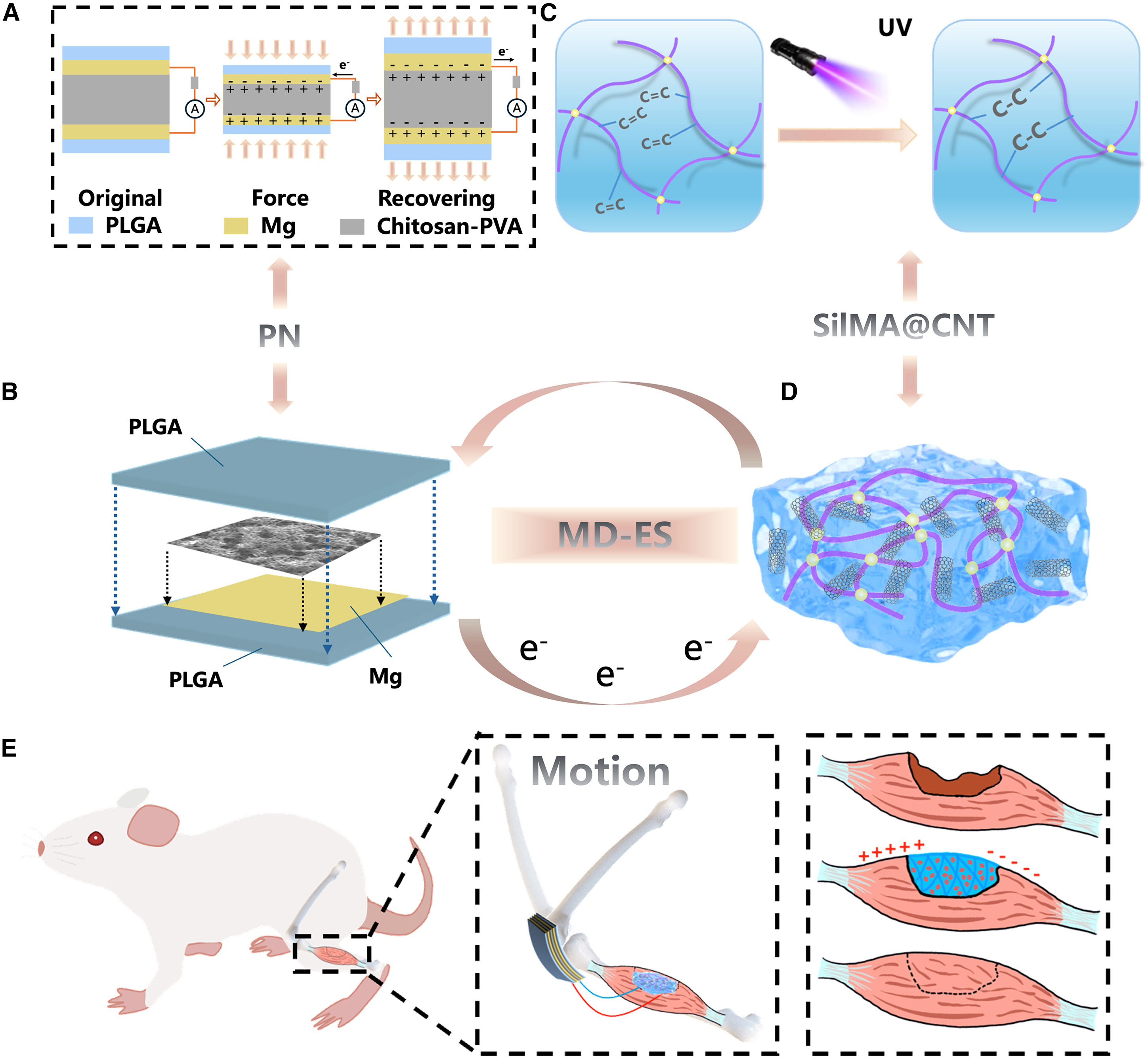
Schematic illustration of structural design and skeletal muscle repair application for MD-ES self-powered system (Image by LI Qi)
<関連情報>
- https://english.cas.cn/newsroom/research-news/202602/t20260210_1150337.shtml
- https://www.cell.com/cell-biomaterials/fulltext/S3050-5623(25)00305-8
筋肉の修復を促進する、完全に生分解性の自己発電型電気刺激装置 Fully biodegradable, self-powered electrical stimulator for enhanced muscle repair
Jingzong Qu ∙ Ruiyang Sun ∙ Tianhe Jiang ∙ … ∙ Tao Sun ∙ Qi Li ∙ Shuo Bai
Cell Biomaterials Published:January 16, 2026
DOI:https://doi.org/10.1016/j.celbio.2025.100314
The bigger picture
Massive skeletal muscle injury (VML, volumetric muscle loss) not only causes severe local pain, loss of motor function, and formation of fibrotic scars after repair, but it may also induce systemic complications such as rhabdomyolysis, electrolyte disturbance, and renal impairment, which seriously endanger physical health and even life safety. Electrical stimulation (ES) is proven to be an effective way to promote VML repair. However, traditional ES devices face drawbacks as they are bulky, have an external power reliance, and often require a second surgery to remove—all of which can harm patients. To solve these problems, we created a fully degradable, self-powered electrical stimulator for muscle injury repair. The electrical stimulator uses low-cost, biocompatible chitosan as the key piezoelectric material, mixed with degradable polyvinyl alcohol (PVA) to form a composite membrane. Even after 5,000 repeated pressure cycles, this membrane stably produces approximately 500 mV of voltage, making it one of the best-performing chitosan-based piezoelectric materials reported to date. Powered by knee-joint movements, the stimulator delivers in situ ES to a conductive hydrogel scaffold implanted at the injury site. Combined with tissue engineering techniques, this self-powered ES system boosts the growth and differentiation of myoblast cells to accelerate repair. In a rat skeletal muscle injury model, the ES system realizes full muscle recovery within 2 weeks, and the stimulator itself completely degrades after about 4 weeks. Overall, this device paves the way for better biodegradable, self-powered implantable ES therapies for muscle repair.
Highlights
- Chitosan-PVA membrane is developed as fully degradable, self-powered ES system
- The membrane generates a ∼500 mV stable voltage over 5,000 pressure cycles
- Integrated with a conductive hydrogel, the system accelerates muscle recovery
Summary
Electrical stimulation (ES) is effective for muscle defect repair, yet traditional systems suffer from bulkiness, external power reliance, and removal-related secondary surgery. Herein, we developed a fully degradable, self-powered ES device using biocompatible, low-cost chitosan as the core piezoelectric material, combined with degradable PVA to form a composite membrane. The membrane stably generates a ∼500 mV voltage over 5,000 pressure cycles, among the highest performances for piezoelectric chitosan. Harvesting knee-joint movement energy, it delivers in situ ES to implanted conductive hydrogel scaffolds, boosting myoblast proliferation and differentiation. In rat models, it enabled full muscle recovery within 2 weeks and fully degraded in 4 weeks, promising to advance implantable ES therapy for muscle repair.