2026-01-19 中国科学院(CAS)
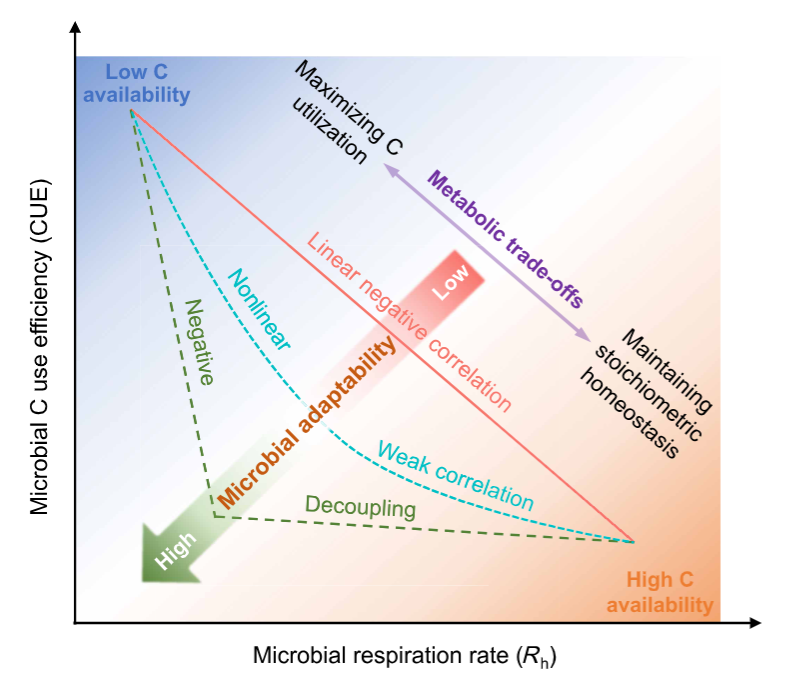
Conceptual framework illustrating the possible relationships between microbial CUE and Rh on the basis of stoichiometric theory and microbial community theory. (Image by CUI Yongxing, et al)
<関連情報>
- https://english.cas.cn/newsroom/research-news/202602/t20260210_1150335.shtml
- https://www.science.org/doi/10.1126/sciadv.adz5319
世界の土壌における微生物の炭素利用効率と呼吸の生産性主導の分離 Productivity-driven decoupling of microbial carbon use efficiency and respiration across global soils
Yongxing Cui, Shushi Peng, Manuel Delgado-Baquerizo, Daryl L. Moorhead, […] , and Matthias C. Rillig
Science Advances Published:14 Jan 2026
DOI:https://doi.org/10.1126/sciadv.adz5319
Abstract
Despite extensive research on soil microbial carbon (C) use efficiency (CUE), its linkage to actual soil C storage remains ambiguous. A key uncertainty is that CUE estimates from short-term labeling incubations assume a linear negative relationship with respiration rates, overlooking nonlinear interactions and long-term microbial acclimation. Here, we use a stoichiometry-based approach to estimate CUE (CUEST), which links soil resource availability to microbial demand and captures microbial adaptability under resource constraints. We synthesized 1094 paired observations of CUEST and heterotrophic respiration rate (Rh) across natural ecosystems and found a nonlinear relationship between them governed by ecosystem productivity. In low-productivity arid and cold regions, CUEST declined with increasing Rh, whereas in productive tropical and temperate regions, CUEST stabilized at a low level (0.27 ± 0.11) as Rh exceeded 340 ± 10.8 grams of C per square meter per year. This shift reflects microbial trade-offs between C assimilation and stoichiometric homeostasis, revealing a decoupling of microbial growth from respiration that limits the capacity of productive ecosystems to store additional soil C.