2026-01-13 マックス・プランク研究所
<関連情報>
- https://www.mpg.de/25996305/0113-limn-why-female-mice-choose-multiple-mates-153345-x
- https://link.springer.com/article/10.1186/s12862-025-02478-5
環境の質が多重父子関係の適応度報酬を形作る Environmental quality shapes the fitness payoffs of multiple paternity
Fragkiskos Darmis & Anja Guenther
BMC Ecology and Evolution Published:01 December 2025
DOI:https://doi.org/10.1186/s12862-025-02478-5
Abstract
Background
Polyandry is widespread in nature and, in polygynandrous species, can lead to multiple paternity when a litter is sired by more than one male. Such multiply-sired litters have been suggested to produce benefits in low-quality environments that may be masked in higher-quality environments. So far, however, the effect of environmental quality has only been tested in birds with equivocal evidence. Here, we use 202 female house mice (Mus musculus domesticus) from 5 generations (4 years; Nobservations=255) that lived in semi-natural enclosures. We provided different enclosures with a different food quality to test the environment dependency of multiply-sired litters as well as its fitness consequences for females.
Results
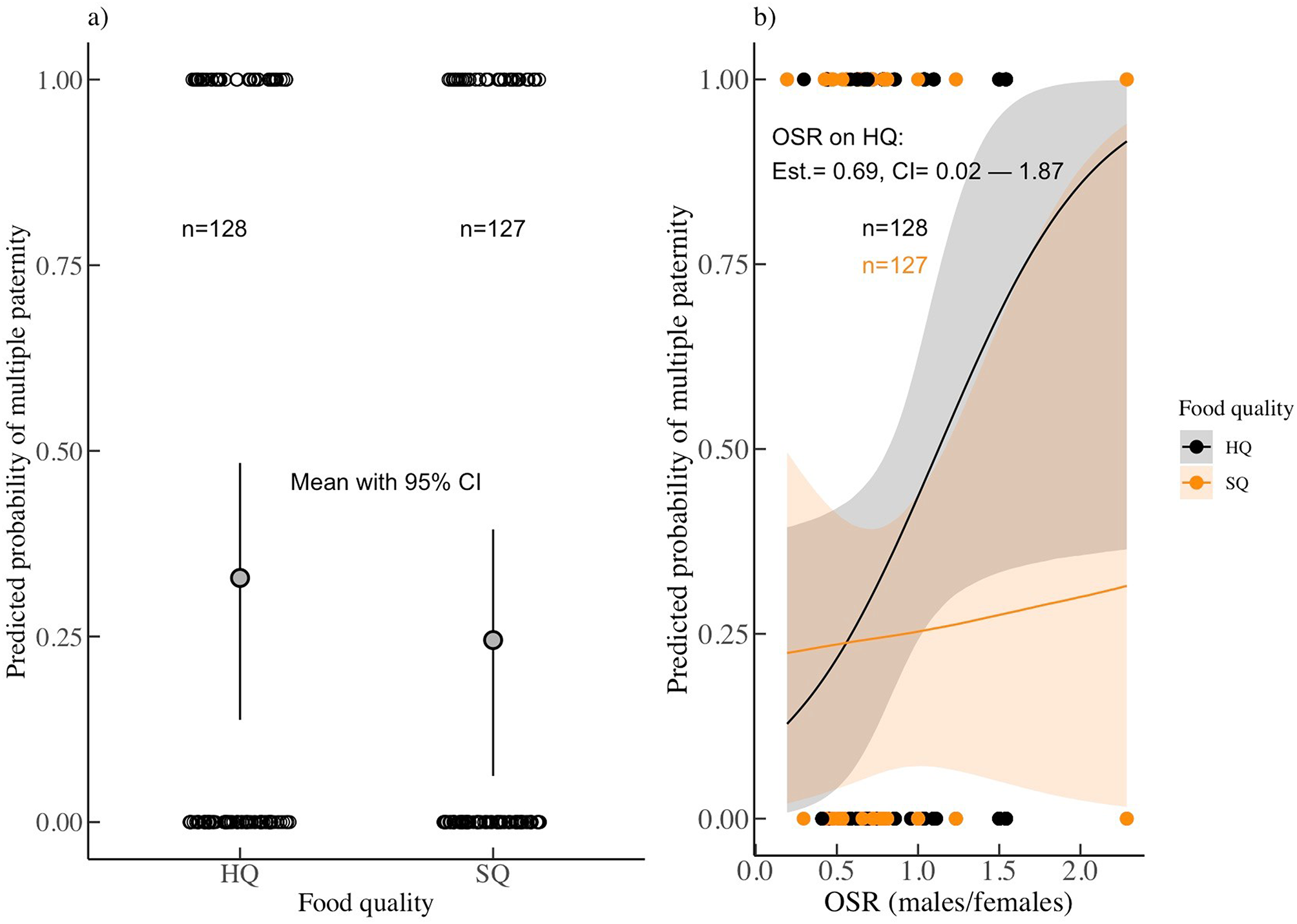
As the operational sex ratio became male-skewed, the incidence of multiple paternity increased, indicating that under high male-male competition males might coerce females or females might mate multiply to reduce infanticide risk. We also found that the advantages of polyandry depended on environmental quality: only in poorer quality environments females that produced offspring with multiple males weaned significantly larger litters. Variation in lifetime reproductive success was significantly predicted by the female tendency towards multiple paternity, with this relationship showing a complex non-linear pattern in both environments. Importantly, our results suggested that polyandry provides greater lifetime fitness benefits when resources are of poorer quality. In other words, polyandry potentially yields its greatest advantages when resources are a limiting factor, but contributes little when conditions are already favourable.
Conclusions
Our study shows that ecological and social conditions interact to shape the fitness consequences of polyandry, with resource quality emerging as a key factor. These context-dependent benefits highlight how resource availability may influence the evolutionary maintenance of polyandrous mating in multi-male, multi-female systems.