2026-02-04 国立成育医療研究センター
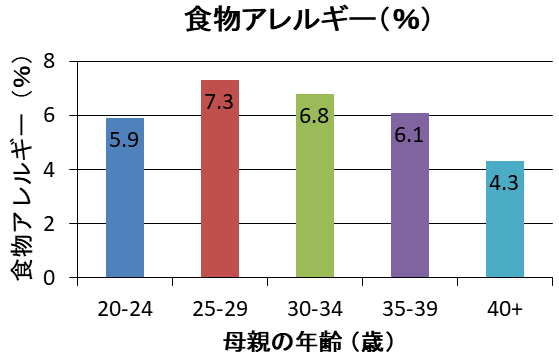
【図1:出産時の母親の年齢と子どもの1歳時の食物アレルギー】
<関連情報>
- https://www.ncchd.go.jp/press/2026/0204.html
- https://www.ncchd.go.jp/press/assets/0204.pdf
- https://jamanetwork.com/journals/jamanetworkopen/fullarticle/2844075
親の年齢と子供のアレルギーリスク Parental Age and Childhood Allergy Risk
Kiwako Yamamoto-Hanada, MD, PhD; Daisuke Harama, MD, PhD; Miori Sato, MD;et al
JAMA Network Open Published:January 20, 2026
DOI:10.1001/jamanetworkopen.2025.54694
Key Points
Question Is advanced maternal age associated with the risk of allergic diseases in early childhood?
Findings In this nationwide prospective birth cohort study of 34 942 children in Japan, children of mothers aged 35 years or older had lower odds of physician-diagnosed food allergy at age 1 year. Similar inverse associations were observed for wheezing, eczema, and house dust mite sensitization through age 4 years.
Meaning These findings suggest that advanced maternal age may be protective against the development of allergic diseases in early childhood, potentially owing to behavioral, environmental, or biological factors associated with older parenthood.
Abstract
Importance Allergic diseases in children are influenced by gene-environment interactions. Although advanced parental age has been associated with genetic and epigenetic changes, its relationship with childhood allergy risk remains unclear.
Objective To examine the association between parental age at childbirth and the risk of allergic diseases in early childhood.
Design, Setting, and Participants This nationwide, multicenter, population-based, prospective birth cohort study used data from the Japan Environment and Children’s Study (JECS). Participants were enrolled at 15 regional centers in Japan between January 2011 and March 2014, with follow-up data collected at child ages 1, 2, and 4 years. The present analysis was conducted from July 8, 2024, to February 4, 2025. Eligible participants were singleton live births with data on parental age and allergic outcomes. Physician-diagnosed allergy outcomes were collected via parental report. House dust mite (HDM) sensitization was assessed in a subcohort.
Main Outcomes and Measures The primary outcomes were physician-diagnosed food allergy, wheeze, asthma, and eczema at ages 1, 2, and 4 years. The secondary outcome was HDM sensitization at ages 2 and 4 years. Adjusted odds ratios (ORs) were calculated using multivariable logistic regression after multiple imputation for missing values.
Results A total of 34 942 mother-child pairs were included; the mean (SD) maternal age at entry was 31.0 (4.7) years, and 17 892 mothers (51.2%) had a medical allergy history. The prevalence of food allergy at age 1 year was 6.6% (95% CI, 6.4%-6.9%), decreasing with maternal age. Compared with children of mothers aged 25 to 29 years, those of mothers aged 35 to 39 years (OR, 0.79; 95% CI, 0.70-0.90) and aged 40 years and older (OR, 0.59; 95% CI, 0.44-0.79) had lower odds of food allergy. Children of parents both aged 35 years or older had lower odds of wheezing at age 4 years (OR, 0.89; 95% CI, 0.82-0.95). HDM was assessed in 1991 children at age 2 years and 1840 children at age 4 years, and children of older mothers also had lower odds of HDM sensitization (children of mothers aged 30-34 years, OR, 0.76; 95% CI, 0.59-0.98; children of mothers aged 35-39 years, OR, 0.68; 95% CI, 0.50-0.91).
Conclusions and Relevance In this cohort study of 34 942 mother-child pairs, children of older mothers had reduced odds of food allergy, wheezing, and HDM sensitization in early childhood, suggesting that advanced maternal age may be protective against the development of allergic diseases in early childhood.