2026-02-17 ノースカロライナ州立大学(NC State)
<関連情報>
- https://news.ncsu.edu/2026/02/perception-of-body-prosthetics/
- https://academic.oup.com/pnasnexus/article/5/2/pgag016/8487341
新しい身体の投影:ウェアラブルロボットによる歩行学習中に身体イメージがどのように変化するか Projecting the new body: How body image evolves during learning to walk with a wearable robot
I-Chieh Lee,Huan Min,Ming Liu,He Huang
PNAS Nexus Published:17 February 2026
DOI:https://doi.org/10.1093/pnasnexus/pgag016
Abstract
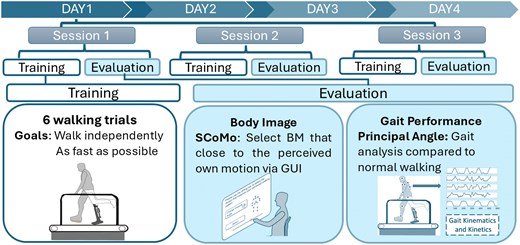
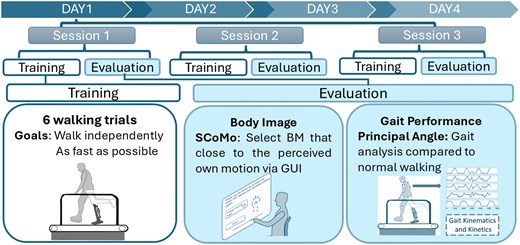
Advances in wearable robotics challenge the traditional definition of human motor systems, as wearable robots redefine body structure, movement capability, and wearers’ perception of their bodies. While these devices can empower the wearer’s motor performance, there is limited understanding of how they affect the wearer’s conscious, subjective experience of their own body (or body image), especially with regard to dynamic movements. This study examined changes in perceived body image as individuals learned to walk with a robotic leg over multi-day training. We measured gait performance and perceived body image via the selected coefficient of perceived motion after each training session. By extending human motor learning theory to wearer–robot systems, we hypothesized that perceived body image when walking with a robotic leg co-evolves with actual gait improvement and becomes more certain and more accurate to actual motion. Our results confirmed that motor learning improved both physical and perceived gait patterns toward normal, indicating that via practice the wearers incorporated the robotic leg into their sensorimotor systems to improve wearer–robot movement coordination. However, a persistent discrepancy between perceived and actual motion remained, likely due to the absence of direct sensation/control of the prosthesis. Additionally, the perceptual overestimation at later training sessions might limit further motor improvement. These findings suggest that enhancing the human sense of wearable robots and frequently calibrating the perception of body image are essential for effective training with wearable robots and for developing embodied assistive technologies.