
2026-10-01 マウントサイナイ医療システム(MSHS)
<関連情報>
- https://www.mountsinai.org/about/newsroom/2026/mount-sinai-researchers-identify-a-brain-circuit-that-remembers-stresses-to-help-shape-reaction-to-them
- https://www.nature.com/articles/s41586-026-11075-5
扁桃体から視床下部前部への回路がストレス感受性を制御する An amygdala to anterior hypothalamic circuit gates stress sensitivity
Zachary T. Pennington, Alexa R. LaBanca, Afra N. Mahmud, Shereen D. Abdel-Raheim, Madeline E. Bacon, Patlapa Sompolpong, BumJin Ko, Austin M. Baggetta, Yosif Zaki, Yu Feng, Zhe Dong, Alexander C. W. Smith, Tristan Shuman, Paul J. Kenny & Denise J. Cai
Nature Published:30 September 2026
DOI:https://doi.org/10.1038/s41586-026-11075-5
Abstract
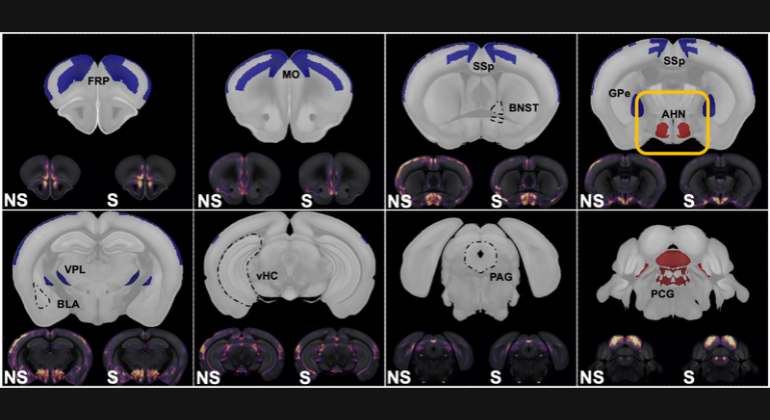
Previous adversity increases sensitivity to subsequent stressful events1,2,3,4,5,6,7,8, but the causal underlying changes in brain circuitry are poorly understood. Here we harnessed unbiased whole-brain activity mapping to identify circuits that are functionally remodelled by previous adversity to promote heightened stress sensitivity. The anterior hypothalamic nucleus (AHN)—a region that has received little attention until now in the context of stress—displayed heightened stress reactivity in previously stressed mice. This was accompanied by increased correlational strength between the AHN and a threat-related brain network. Using in vivo Miniscope imaging, we then found that neuronal activity in the AHN scales with negative valence. Moreover, previous stress amplified the proportion of valence-sensitive AHN neurons, indicating inflated processing of negative valence in the AHN might drive heightened stress sensitivity. Providing causal support for the role of AHN in negative valence and stress sensitivity, inhibiting AHN neurons blunted, and exciting their activity promoted, stress responses. Finally, amygdala neurons that project to the AHN were found to track negative valence, and silencing amygdala inputs to the AHN abolished sensitized stress responses. These findings define a key role of the AHN in regulating negative valence signals from the amygdala and highlight a new pathway that heightens sensitivity to stressful events.

