2026-09-29 カリフォルニア大学サンタクルーズ校
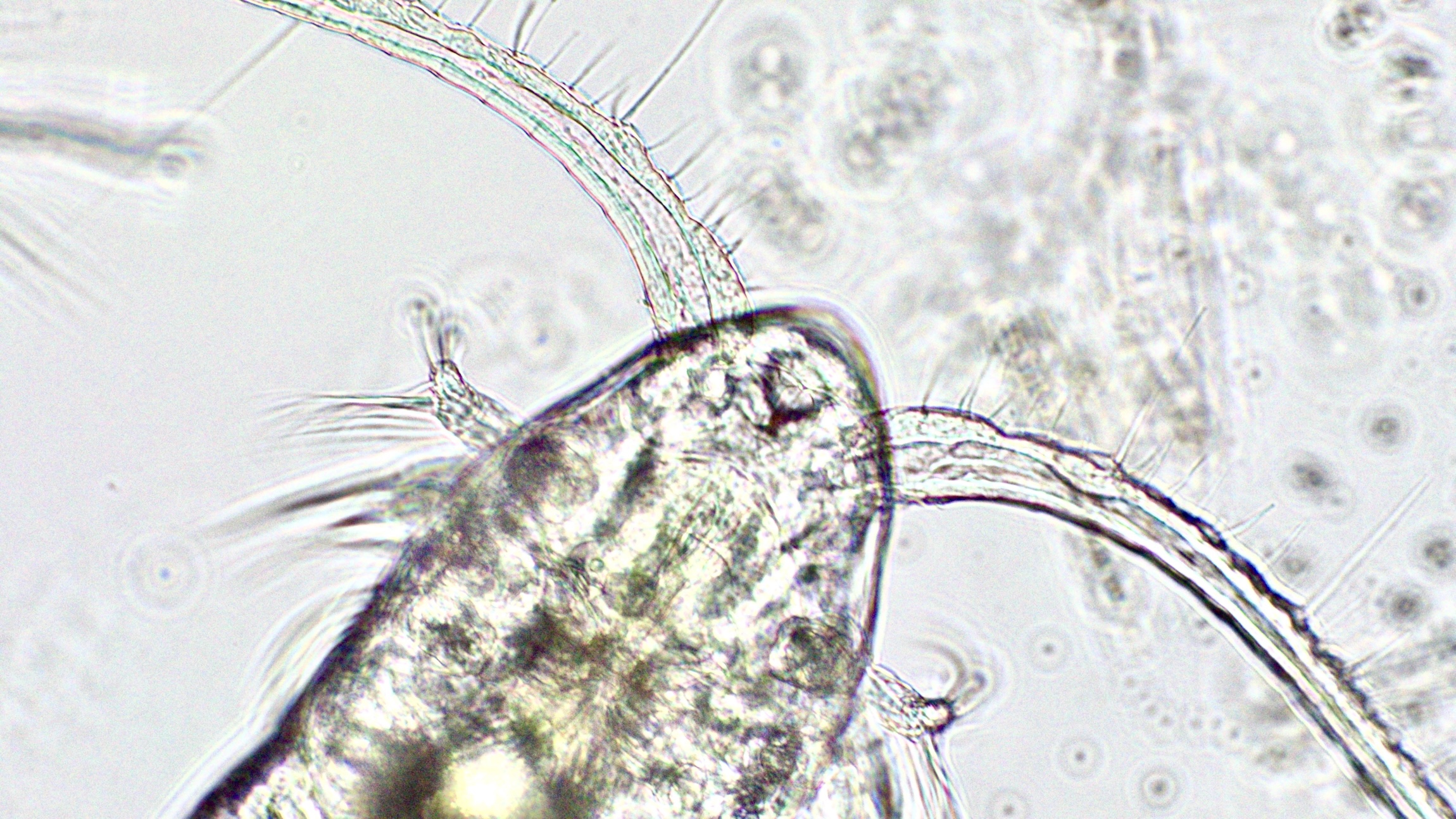
A calanoid copepod under 100x magnification. Picture taken at the Salish Sea Research Center at Northwest Indian College, a collaborator on the project. Photo by Aubrey Trapp
<関連情報>
- https://news.ucsc.edu/2026/09/algal-bloom-detection/
- https://www.pnas.org/doi/10.1073/pnas.2604233123
草食動物のシグナルをパッシブサンプリングすることで、有害藻類ブルームのモニタリングと毒素予測にトップダウン効果を取り入れることができる Passive sampling for grazer cues incorporates top-down effects in harmful algal bloom monitoring and toxin prediction
Aubrey Trapp, Ada Behncké-Serra, Erik Selander, +1 , and Raphael M. Kudela
Proceedings of the National academy of Sciences Published:September 30, 2026
DOI:https://doi.org/10.1073/pnas.2604233123
Abstract
Domoic acid (DA) produced by toxigenic species of the diatom genus Pseudo-nitzschia during harmful algal blooms (HABs) bioaccumulates in filter feeders, bait fish, and commercial seafood products, posing a threat to marine organisms and public health. Copepodamides, a group of polar lipids exuded by copepods, are known to induce DA production in multiple species of Pseudo-nitzschia. However, copepodamides are not currently considered in HAB monitoring and prediction, in part because of challenges associated with measuring ambient concentrations of dilute and labile compounds. Here we employ solid phase adsorption toxin tracking (SPATT) to measure natural concentrations of copepodamides over 28 mo in Monterey Bay, California, a known hotspot for HAB events. Copepodamides were significantly correlated to copepod biovolume, confirming utility as a zooplankton proxy. In generalized linear models, copepodamides from SPATT provided greater accuracy and lead time for predicting Pseudo-nitzschia abundance and DA concentration in sentinel mussels than DA from SPATT. Field experiments in the Northeast Atlantic assessed sampling methodology, and lab experiments demonstrated DA induction in Pseudo-nitzschia multiseries isolated from Monterey Bay. Results show potential for copepodamides to improve HAB predictions and encourage development of novel approaches to include top-down information in HAB monitoring systems.